Digital and Physical Experiences Feel Disconnected
Customers describe the digital experience as inconsistent with what they receive through branches, offices, contact centres or other human channels.

How we can help
Seamless customer experiences across every digital channel.
Customers do not experience an organisation's app, website, USSD channel, social platform or contact centre as separate systems. They experience one relationship with one organisation. When information, service levels, functionality or processes differ between channels, customers experience the inconsistency as friction, regardless of how sophisticated any individual platform may be.
Digital customer experience is therefore about more than improving interfaces or introducing new technology. It is about designing a coherent end-to-end experience in which customers can move between channels easily, complete what they came to do and receive a consistent standard of service wherever they interact with the organisation.
We help organisations design and improve digital experiences across channels. For public institutions, this includes designing digital services that make access to government services easier and more citizen-centred.
We connect customer journeys, digital platforms, service processes and human support so the overall relationship feels simpler, more intuitive and more consistent.
The result is a digital experience customers choose to use because it is easier, more consistent and more effective than the alternative.
Mapping and redesigning end-to-end digital journeys around customer needs, behaviours and desired outcomes.
Defining the role of each digital channel and improving how channels work together to create a coherent customer experience.
Assessing digital journeys, usability, friction points and performance against customer expectations and relevant market benchmarks.
Designing connected experiences across digital and physical channels so customers can move between touchpoints without unnecessary repetition or disruption.
Redesigning digital government services around citizen needs, accessibility and ease of use, while recognising the operational realities behind public service delivery.
Identifying the barriers that prevent customers from completing digital journeys and designing interventions to improve adoption, engagement and conversion.
Aligning front-end digital experiences with the underlying processes, data, systems and human support required to deliver the promised service.
Digital experience becomes a liability rather than an asset when the platform improves in isolation while the underlying service stays exactly the same.
The common thread: digital investment has focused on the platform, not on the underlying journey the platform is meant to improve.
Customers describe the digital experience as inconsistent with what they receive through branches, offices, contact centres or other human channels.
A new digital channel was introduced to improve convenience or reduce cost, but customers find the process harder to navigate than the original service.
Significant investment has been made in digital platforms, yet customers continue to rely heavily on traditional channels or abandon digital journeys before completion.
The app, website, USSD channel and other digital touchpoints use different information, processes, terminology or service standards, creating a fragmented experience.
Customers regularly begin a digital process but fail to complete it, without the organisation having a clear understanding of where or why they drop out.
Customers start a transaction digitally but have to call, visit a branch or contact an employee to complete it because the digital journey cannot resolve the need end to end.
Success is defined by whether a platform has been delivered rather than whether customers are actually using it, completing journeys and experiencing better outcomes.
A digital interface has been placed over an inefficient or fragmented process, leaving customers to experience the same organisational complexity through a new channel.
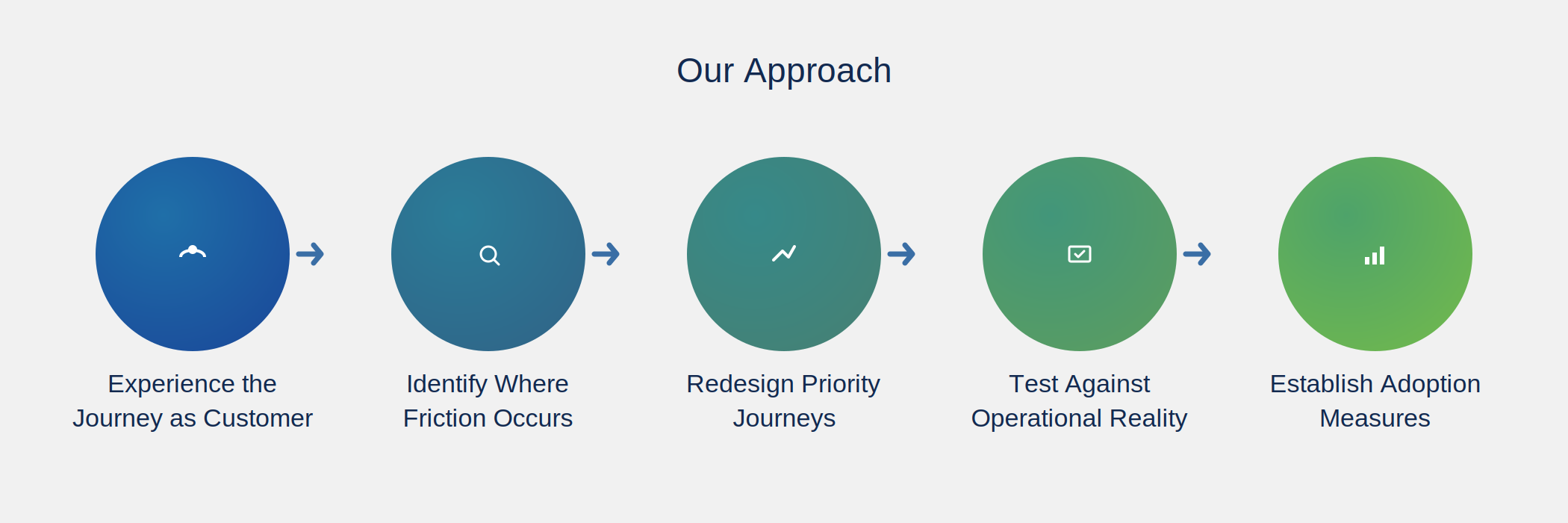
We begin by experiencing the digital journey from the customer's perspective, examining how people actually discover, navigate, use and complete services across devices and channels.
We combine customer insight, journey analytics, usability assessment and operational evidence to identify the moments where customers experience friction, abandon a process or move unnecessarily between channels.
We then redesign priority journeys around the outcomes customers are trying to achieve, simplifying interactions and ensuring that digital channels work as part of a connected service rather than as standalone platforms.
Our recommendations are tested against the organisation's operational and technology realities, ensuring that the desired experience can actually be delivered and sustained.
We also establish practical measures for tracking adoption, completion, abandonment, satisfaction and channel performance.
The objective is not simply to create better digital platforms. It is to create digital experiences that customers choose to use because they are easier, more consistent and more effective.