Customer Data is Plentiful but Underused
Customer data is collected extensively across multiple channels, but rarely changes a significant business decision or informs a clear action.

How we can help
Customer data turned into decisions, not just dashboards.
Most organisations are not short of customer data. They are short of a clear route from that data to better decisions. Customer information can be collected across surveys, transactions, digital channels, complaints and interactions, yet still fail to answer the questions that matter most to the business. Insight only creates value when it changes what an organisation understands, decides and does.
We turn customer research and data into actionable insight that supports better commercial and operational decisions. By connecting customer evidence with business priorities, we help organisations understand what customers value, why behaviours change and where intervention can create the greatest impact.
Our focus is not simply on producing more analysis, but on making customer intelligence usable, timely and connected to action.
We build practical insight-to-action disciplines that enable organisations to continuously learn from their customers and make better-informed decisions.
Designing and delivering targeted qualitative and quantitative research that answers the questions most important to commercial, strategic and operational decision-making.
Developing practical approaches for integrating customer data sources, improving data quality and turning fragmented information into a reliable foundation for insight.
Establishing structured mechanisms for capturing, analysing and acting on customer feedback across channels, journeys and key interactions.
Identifying meaningful customer segments based on needs, behaviours, value and potential, enabling more targeted propositions, experiences and engagement strategies.
Applying customer data to identify behavioural patterns, anticipate customer needs and inform decisions around acquisition, retention, cross-selling and service improvement.
Identifying the factors driving customer attrition and developing evidence-based interventions to strengthen retention, loyalty and customer lifetime value.
Translating complex customer data into clear, decision-ready dashboards and management reporting that highlight trends, risks, opportunities and actions.
Creating practical mechanisms that connect customer insight to decisions, accountability and measurable action, ensuring intelligence does not end in a report.
Customer insight becomes a wasted investment when data keeps accumulating but decisions keep being made the same way they always were.
The common thread: the organisation has plenty of customer data but no reliable path from that data to a better decision.
Customer data is collected extensively across multiple channels, but rarely changes a significant business decision or informs a clear action.
Marketing, sales, operations and customer service teams draw different conclusions from the same customer data because there is no shared view of customer behaviour and needs.
Customer research is commissioned after a problem has emerged rather than being used proactively to anticipate changing needs, identify opportunities or guide strategic choices.
Sophisticated dashboards and reports are available, but the people responsible for making decisions rarely use them or translate the information into action.
The organisation cannot confidently explain why customers leave, what drives loyalty or which interventions are most likely to retain valuable customers.
The organisation treats customers too broadly, without a sufficiently clear understanding of differences in needs, behaviour, value or growth potential.
Customer intelligence sits primarily within analytics or research functions rather than informing strategy, operations, product development and frontline decision-making.
Leadership teams make important commercial or service decisions based on experience and assumptions because reliable customer evidence is difficult to access or interpret.
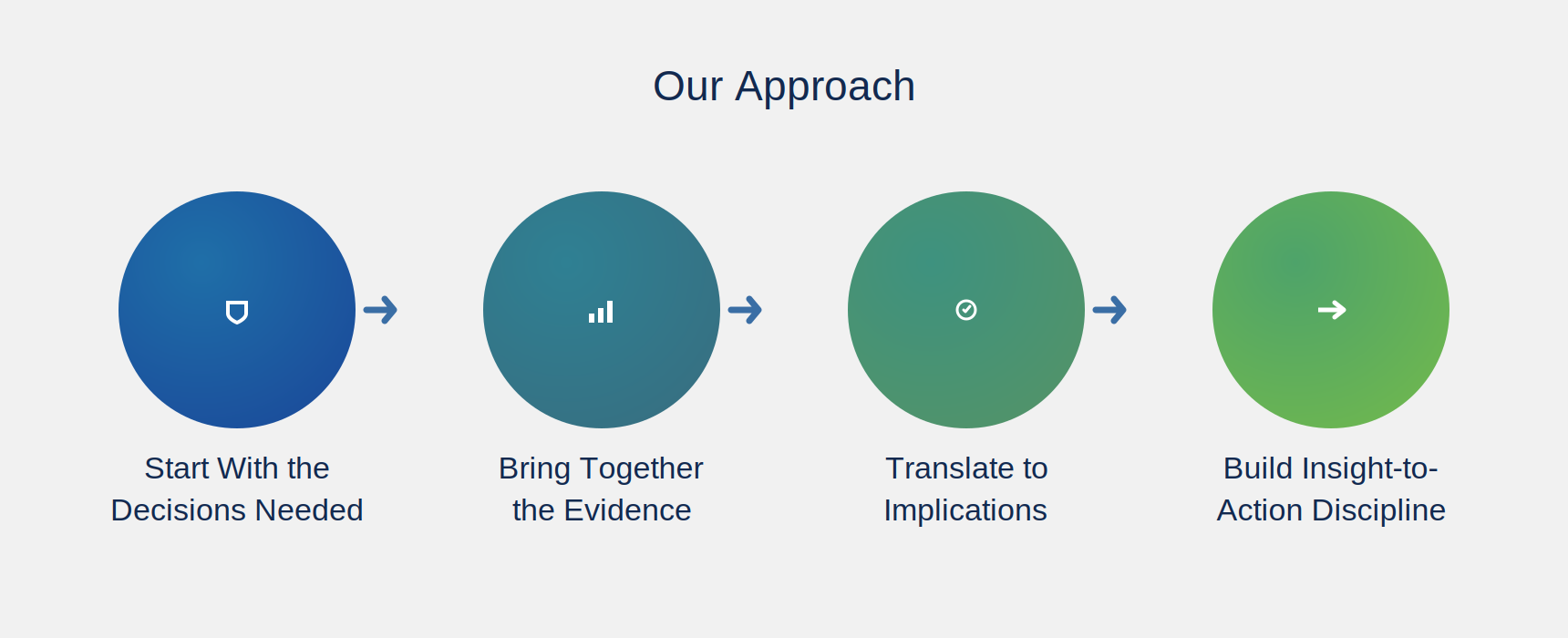
We start with the decisions the organisation needs to make, then determine what customer evidence is required to make those decisions with greater confidence. This prevents research and analytics from becoming exercises in data collection and ensures that every insight has a clear purpose.
We bring together customer research, behavioural data, operational evidence and market context to develop a more complete picture of the customer. Where appropriate, we use segmentation, journey analysis and predictive techniques to identify patterns that are not immediately visible in conventional reporting.
We then translate findings into clear implications for the business, identifying what should change, where action should be prioritised and who needs to own it.
Our approach ensures that customer intelligence does not end in a report or remain within an analytics function. We build practical insight-to-action disciplines that enable organisations to continuously learn from their customers.
The emphasis is on moving from data to insight, insight to decision and decision to measurable action.