No Shared Customer View
Different departments have different ideas about who the customer is, what they value and which customers matter most.

How we can help
Customer strategies that create clarity, focus and lasting competitive advantage.
Customers are not simply a market to be served. They are the starting point for some of the most consequential choices an organisation makes: where to compete, whom to prioritise, what value to create and how to organise around delivering it.
Yet many organisations know their customers without having a truly shared customer strategy. Different functions pursue different priorities, investments become fragmented, customer initiatives compete rather than compound, and “customer-centricity” remains an aspiration rather than a disciplined set of choices.
At Concinnity, we help organisations answer the fundamental questions this raises, who to serve, what to value, where to differentiate, and translate customer insight into clear strategic choices and coordinated action. We bring together customer understanding, market perspective, competitive analysis and organisational realities to develop strategies that are commercially grounded and executable.
We help organisations move beyond customer-centricity as a slogan to make it an enterprise-wide discipline, one that guides where to invest, how to differentiate, which capabilities to build and how to create value for both customers and the organisation.
From understanding the customer to aligning the enterprise, we help organisations make customer strategy a disciplined driver of growth, differentiation and long-term value.
Assess the organisation's current customer strategy, identify gaps and opportunities, and define a clear strategic direction grounded in customer, market and business realities.
Identify and prioritise the customer segments that matter most, understand their needs and economics, and develop differentiated value propositions that strengthen relevance and competitive positioning.
Align structures, processes, capabilities, channels, technology and ways of working around the customer journeys and outcomes the organisation seeks to deliver.
Connect customer priorities to the broader corporate strategy, ensuring growth ambitions, investment decisions, business priorities and customer choices reinforce one another.
Establish the governance, metrics, accountability and decision disciplines required to embed customer strategy into day-to-day management and continuously measure its impact.
Customer strategy becomes a strategic gap when the organisation's decisions and investments no longer share a common view of who matters most and why.
The common thread: the organisation is making customer decisions without a shared, disciplined view of who it is truly built to serve.
Different departments have different ideas about who the customer is, what they value and which customers matter most.
Customer strategy exists as a presentation, but people cannot explain how it influences everyday decisions, priorities or investments.
Customer initiatives multiply without a clear framework for prioritising where investment will create the greatest value.
Customer feedback and data are collected extensively, but rarely translate into meaningful changes in products, services or experiences.
Competitors are winning through a stronger customer experience, even where products, pricing or propositions are broadly comparable.
Customer priorities remain concentrated in marketing, sales or CX teams rather than shaping decisions and capabilities across the organisation.
The organisation is pursuing growth without a clear view of which customers to prioritise, where to compete and where to focus investment.
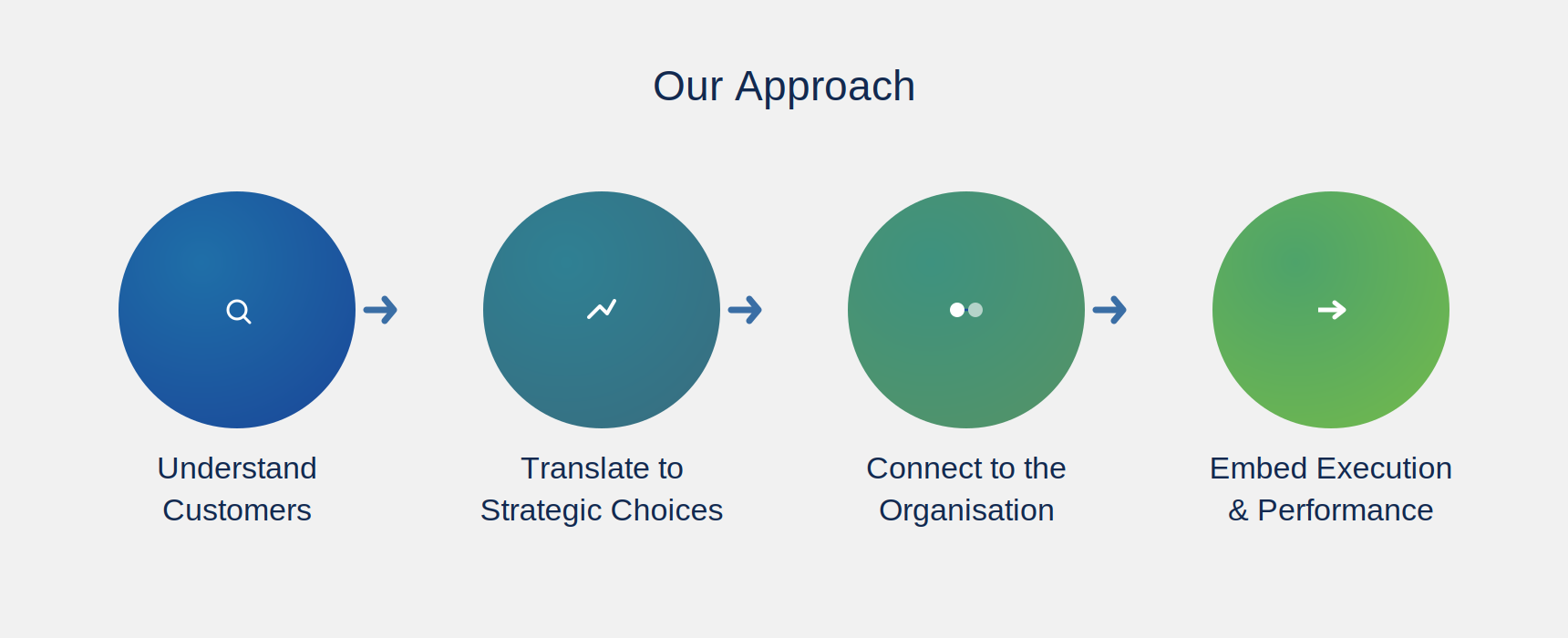
We begin by building a clear, evidence-based understanding of the customers who matter most to the organisation's future: who they are, what they value, how their needs are changing, what drives their choices and where the organisation can create distinctive value. We combine customer insight with market intelligence, behavioural evidence and commercial realities to challenge assumptions and identify the opportunities that matter most.
From this foundation, we translate insight into a focused customer strategy built around explicit choices: which customers to prioritise, which needs and occasions to win, what value proposition to offer, how to differentiate, and where not to compete.
We then connect the customer strategy to the broader organisation, aligning propositions, experiences, channels, capabilities, people and investment priorities around the customers and outcomes that matter most. This ensures customer strategy does not sit in isolation as a marketing agenda, but becomes a shared enterprise framework for decision-making.
Finally, we help embed the strategy into execution and performance management, establishing the measures, governance and decision disciplines needed to test whether the organisation is delivering the value customers expect.
The result is a customer strategy that is not simply a statement of intent, but a practical system for making better choices, concentrating resources and creating distinctive value consistently over time.