Services Have Become Unnecessarily Complex
Services have grown incrementally over years through layers of processes, approvals and controls into something nobody would design from scratch today.

How we can help
Services redesigned around what customers and citizens actually need.
Services rarely fail all at once. More often, they accumulate small compromises over time: another approval added to reduce risk, another handoff introduced to manage workload, another channel bolted onto an existing process, until the overall experience becomes slower, more complex and less responsive than anyone would design today.
Effective service transformation starts by challenging that accumulated complexity. Rather than redesigning services around organisational structures or inherited processes, we start with the outcome the customer or citizen is actually trying to achieve and work backwards to determine what the organisation must do differently to deliver it.
We redesign services, delivery models and channels around genuine customer and citizen needs. For public institutions, this includes citizen-centred transformation that connects institutional reform with the experience people actually have when accessing public services.
We help organisations simplify journeys, remove unnecessary friction and create service experiences that are more accessible, consistent and effective.
The objective is a service that is simpler to access, easier to deliver, more consistent in practice and measurably better for the people who depend on it.
Reimagining end-to-end services around customer and citizen needs, simplifying journeys and removing unnecessary complexity, duplication and friction.
Redesigning public services around the needs, expectations and lived experiences of citizens, with a focus on accessibility, responsiveness and trust.
Reviewing the structures, processes, roles and capabilities behind service delivery and designing a model that can deliver consistently at the required standard.
Designing the right combination of physical, digital, assisted and hybrid channels, ensuring that new channels improve the service rather than simply replicate existing problems.
Establishing clear, measurable service standards and management mechanisms that enable organisations to monitor performance and take corrective action.
Identifying unnecessary approvals, handoffs, repeat interactions and process steps that increase effort for customers, citizens and frontline teams.
Equipping frontline teams and managers with the skills, tools and decision rights required to deliver redesigned services consistently.
Service complexity becomes visible in how often customers and citizens have to work around the organisation, rather than through it, to get what they need.
The common thread: complexity has accumulated faster than anyone has stepped back to redesign the service as a whole.
Services have grown incrementally over years through layers of processes, approvals and controls into something nobody would design from scratch today.
People routinely need to visit, call, submit information or follow up more than once to resolve a request that should be straightforward.
A digital interface has been introduced, but the underlying service, process and organisational structure remain unchanged.
Customers or citizens receive noticeably different levels of service depending on whether they use a branch, call centre, website, mobile channel or physical service point.
Employees closest to customers and citizens understand where the service fails but have no effective mechanism for escalating recurring problems or influencing redesign.
Standards have been documented, but performance against them is rarely measured, reported or used to drive improvement.
Recurring complaints are resolved one case at a time without addressing the underlying process or service design issues creating them.
Multiple teams are making isolated changes to processes, technology or channels without a shared view of the end-to-end service experience.
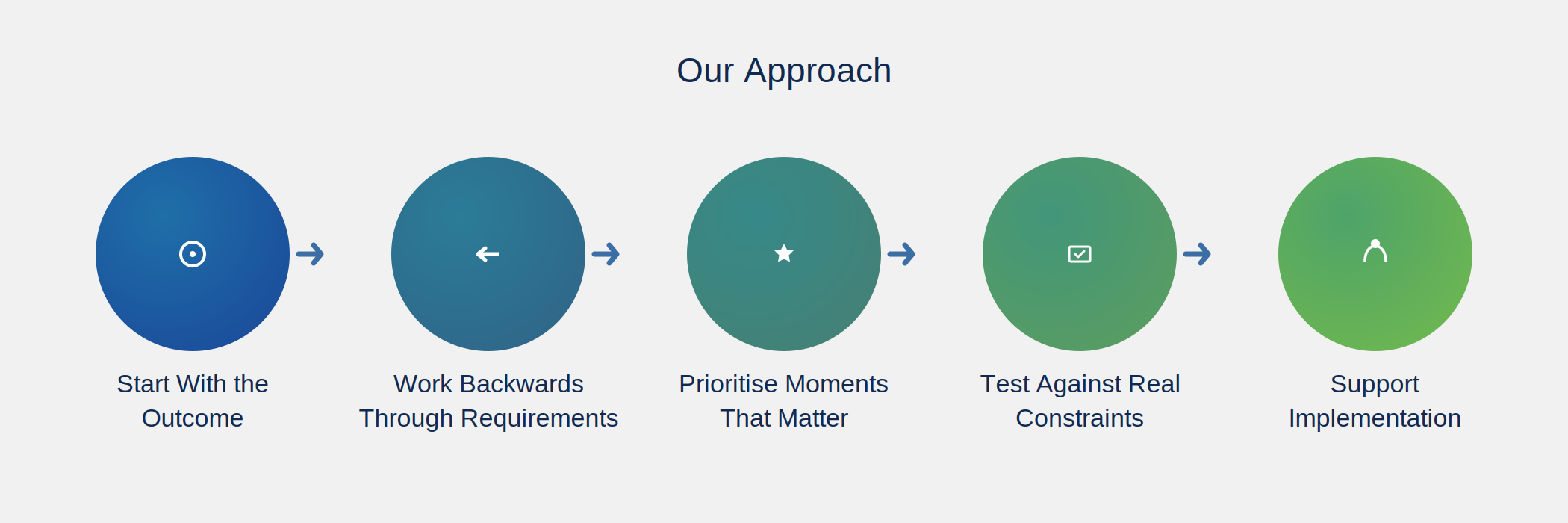
We begin with the outcome the customer or citizen is actually trying to achieve, rather than the process the organisation has inherited. We examine the complete service journey, combining customer and citizen insight with operational evidence to understand where friction, duplication, delay and inconsistency occur.
From there, we work backwards through the processes, channels, technology, roles and decision rights required to deliver the desired outcome reliably. This allows us to distinguish between problems that can be solved through process simplification and those requiring deeper changes to the operating model.
We prioritise redesign around the moments that matter most, focusing first on changes that can materially improve the experience while addressing the structural issues required for sustainable improvement.
Before implementation, proposed changes are tested against the organisation's real operating constraints, including workforce capacity, technology, governance, regulatory requirements and, where relevant, the particular realities of public sector delivery.
We then support implementation through clear service standards, ownership, performance measures and frontline capability, creating the conditions for continuous improvement.
The objective is not simply a better-designed service, but a service that is simpler to access, easier to deliver, more consistent in practice and measurably better for the people who depend on it.