Strategy Rests on a Single Forecast
Strategic planning is built around a single central forecast, with no structured consideration of how the organisation would respond if reality diverges from it.

How we can help
Stress-testing strategy against plausible futures, not one guess.
Strategy built around a single forecast is fragile the moment reality diverges from that forecast, which it almost always does to some degree. The organisations best prepared for an uncertain future are those that have deliberately stress-tested their strategy against multiple plausible scenarios, not just the most likely one.
Forecasting is often treated as a single-point exercise: one number, one projection, presented with a confidence the underlying uncertainty rarely justifies. Scenario planning takes a different approach, exploring a structured range of plausible futures and what each would mean for strategy.
At Concinnity, we help organisations build forecasts and scenarios grounded in rigorous analysis of underlying trends and uncertainties, giving leadership a stronger basis for decisions that must hold up under genuine uncertainty.
We help organisations move beyond single-point forecasts to a disciplined understanding of the range of futures their strategy needs to withstand.
The objective is a strategy that has been deliberately stress-tested against genuine uncertainty, not one built around a single, comforting projection.
Identify and analyse the underlying trends shaping a market, sector or economy, distinguishing durable shifts from short-term noise.
Develop a structured set of plausible future scenarios, built around the key uncertainties most likely to affect the organisation's strategy.
Build demand forecasts grounded in rigorous analysis of historical data, market drivers and relevant comparators.
Model the potential impact of key risks and uncertainties on strategic and financial outcomes.
Test existing strategy against multiple scenarios to identify where it is resilient and where it is vulnerable to specific future conditions.
Forecasting risk becomes visible only once reality has already diverged from the single number everyone was relying on.
The common thread: strategy has been built around a single, plausible future, without deliberately testing what happens if that future does not arrive.
Strategic planning is built around a single central forecast, with no structured consideration of how the organisation would respond if reality diverges from it.
Past forecasts have proven significantly inaccurate, raising questions about the methodology or assumptions behind them.
Leadership has not systematically identified the uncertainties most likely to materially affect the organisation's strategy.
A recent market, economic or competitive shift caught the organisation without a plan for how to respond.
Strategic planning has never included a structured exploration of alternative futures, only the most expected one.
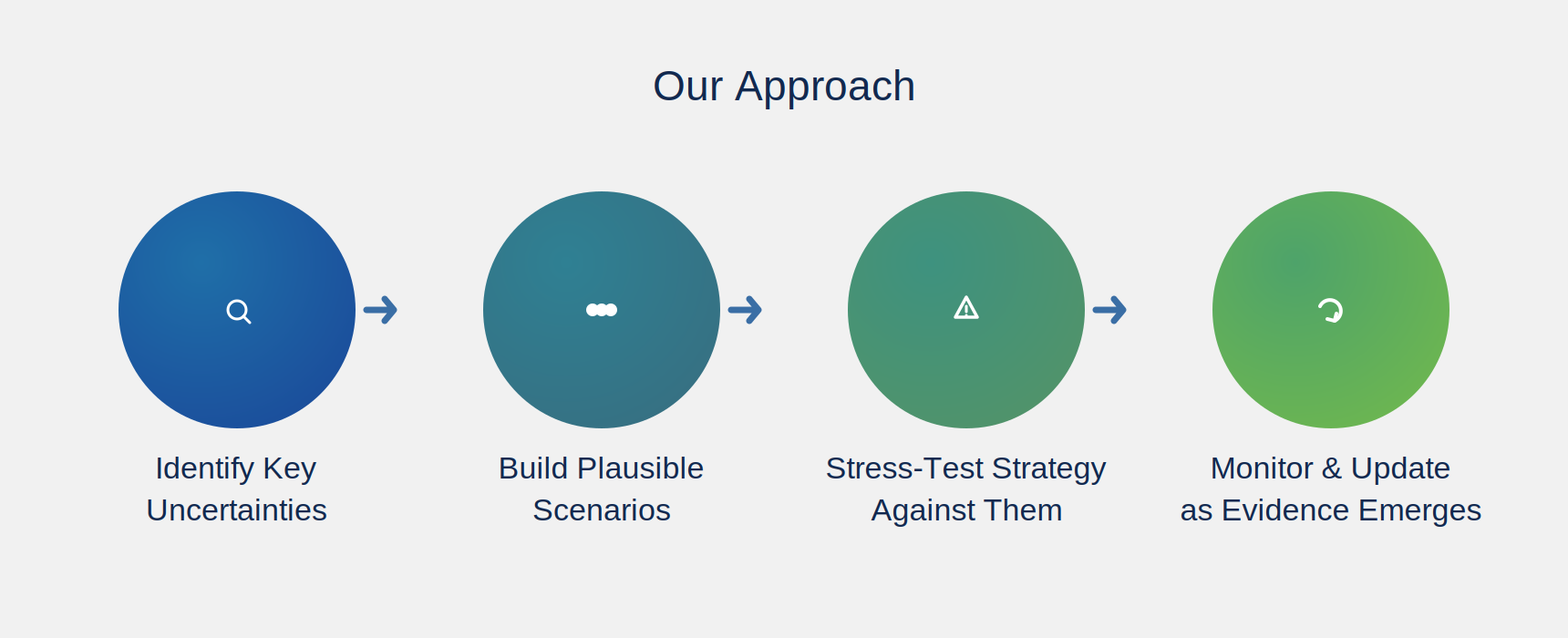
We begin by identifying the key uncertainties most likely to materially affect the organisation's strategy, rather than trying to forecast every possible variable.
We then build a structured set of plausible scenarios around those uncertainties, each internally consistent and genuinely distinct from the others.
Existing or proposed strategy is stress-tested against each scenario, identifying where it holds up and where it is vulnerable.
Since forecasts and scenarios inevitably require updating, we help establish the monitoring mechanisms needed to track emerging evidence and revisit the analysis as conditions evolve.
The result is a strategy that has been genuinely tested against a plausible range of futures, not one built on the comfort of a single forecast.