When the operating model has quietly become the constraint the strategy runs into.
Duplicated Effort: The same task is performed by multiple teams because ownership was never clearly assigned.

How we can help
Redesigning how work gets done to improve performance.
An organisation chart shows who reports to whom. It rarely shows how work actually flows, where value is created or why a process that should take hours takes days. Concinnity helps organisations build simpler, more connected and more effective operating models.
The operating model is the connective tissue between structure and execution: the processes, capabilities, information flows and governance that determine whether work actually gets done efficiently. When it is misaligned, symptoms show up everywhere: duplicated effort across teams, handoffs that create delay rather than value, and technology investments that do not resolve the underlying inefficiency because the model around them was never fixed.
Most organisations do not design their operating model deliberately at all; it accumulates, shaped by successive reorganisations, systems bought for a different era, and workarounds that became permanent. Revisiting it deliberately, rather than layering another fix on top, is often the fastest way to unlock performance that strategy alone cannot deliver.
Concinnity redesigns the target operating model organisations need to translate strategy into consistent, efficient execution.
From process to platform, we help organisations build an operating model that turns strategic intent into everyday operational excellence.
Define the future-state operating model, including structures, functions, governance, processes, capabilities and interfaces required to deliver the organisation's strategy.
Map how work actually flows today and redesign processes to remove duplication, delay and unnecessary complexity.
Assess current operational performance against leading practice to identify where the model is creating friction rather than flow.
Identify where automation can remove manual effort and variability from processes that do not require judgement.
Build the internal capability for the organisation to keep refining its own operating model after the engagement ends.
Individually, these are operational headaches. Together, they signal an operating model that is quietly working against the organisation's own strategy.
Duplicated Effort: The same task is performed by multiple teams because ownership was never clearly assigned.
Work slows down every time it moves between functions, not because the work is hard but because the handoff itself is unclear.
New systems have been implemented, but the inefficiencies they were meant to solve persist.
Workarounds introduced years ago have become permanent, informal parts of how things get done.
The organisation has grown, but its processes and systems still reflect its size several years ago.
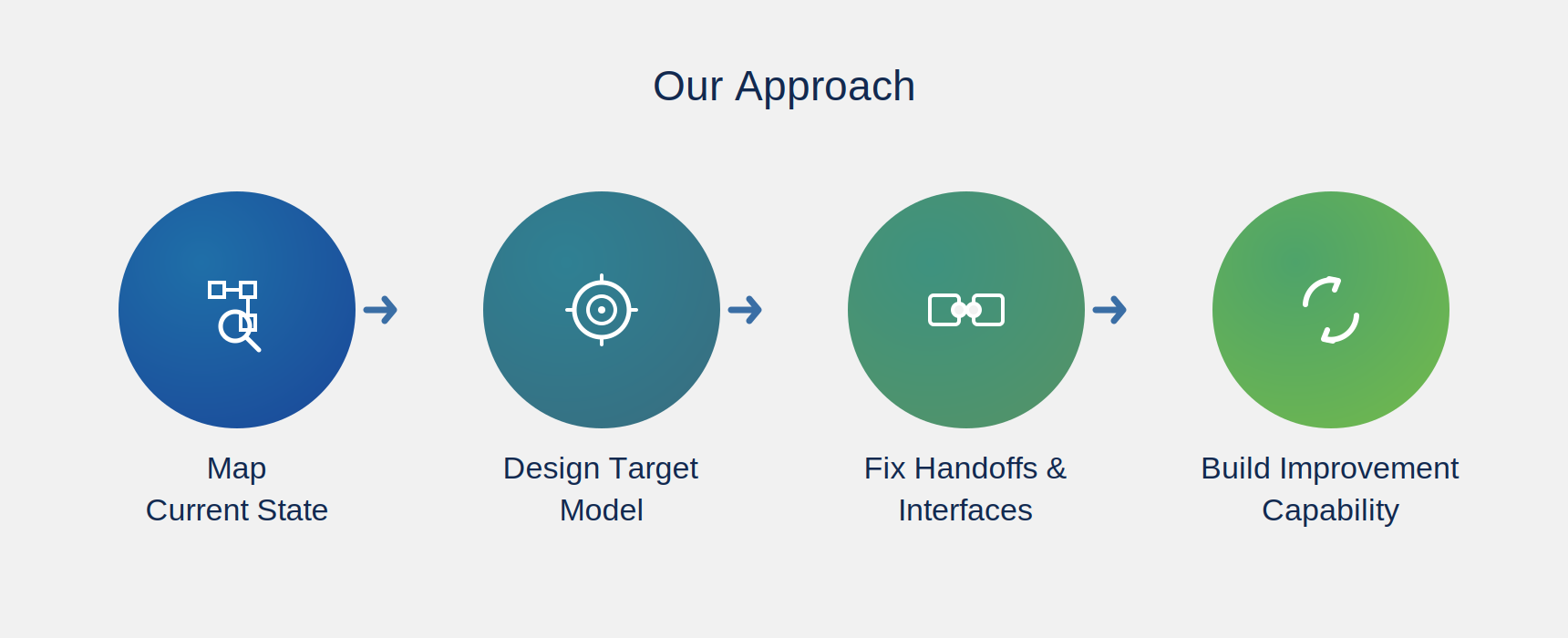
We begin by mapping how work actually happens today, not how it is assumed to happen. This means tracing real process flows, decision points and handoffs, and identifying where effort, time or quality is being lost.
From there, we design the target operating model: the structures, processes, capabilities, governance and interfaces the organisation needs to execute its strategy efficiently. Every design choice is tested against practicality, not just theoretical elegance, since an operating model that cannot be implemented within the organisation's real constraints delivers no value at all.
We pay particular attention to the handoffs and interfaces between functions, since this is where most operating models actually break down, not within any single team's process but between them.
Finally, we help build the organisation's own capability to keep improving the model after we leave, since an operating model is never finished; it needs continuous refinement as the organisation and its market keep changing.
From how work happens today to how it should happen tomorrow. From process to platform. From efficiency to sustained performance.