
When change is being announced but is not actually taking hold.
Change Fatigue: Staff have lived through several change initiatives recently and greet a new one with scepticism rather than energy.

How we can help
Turning organisational change into lasting adoption.
Strategy, structure and technology can all be redesigned on paper. The real test is whether people understand the change, adopt new ways of working and sustain them long after the programme has moved on. Concinnity helps organisations lead change that actually takes hold.
Most change programmes do not fail because the plan was wrong. They fail because the people expected to change never fully understood what was being asked of them, were not meaningfully engaged in shaping it, or were left without the support needed to sustain new behaviour once the programme's attention moved elsewhere.
Change management is often treated as a communications add-on to a “real” workstream, such as a system implementation or a restructuring. Concinnity treats it as a discipline in its own right, since even the best-designed change fails if the people living through it are not brought along deliberately.
Concinnity leads the change strategy, communication and readiness work that turns a planned change into one people actually adopt.
From announcement to adoption, we help organisations manage change as a discipline, not an afterthought.
Build a structured change strategy that sequences communication, engagement and capability-building around the pace people can actually absorb.
Design and deliver the communications and engagement activity that builds understanding and buy-in across every level affected.
Diagnose how ready the organisation genuinely is for the change, identifying where resistance or capability gaps are likely to emerge.
Build networks of change champions who reinforce the change from within their own teams, rather than relying on top-down messaging alone.
Track whether new behaviours are actually being adopted after go-live, and intervene where adoption is stalling.
Individually manageable, together these signs point to a change effort that risks becoming a memo nobody actually lived by.
Change Fatigue: Staff have lived through several change initiatives recently and greet a new one with scepticism rather than energy.
People are following the new process because they were told to, not because they understand or believe in it.
The change had strong energy at launch, but attention and adoption are fading within weeks.
Frontline managers, who are critical to reinforcing change day to day, were never properly engaged or equipped to lead it.
There is no mechanism to actually track whether the change has been adopted, beyond assuming it has.
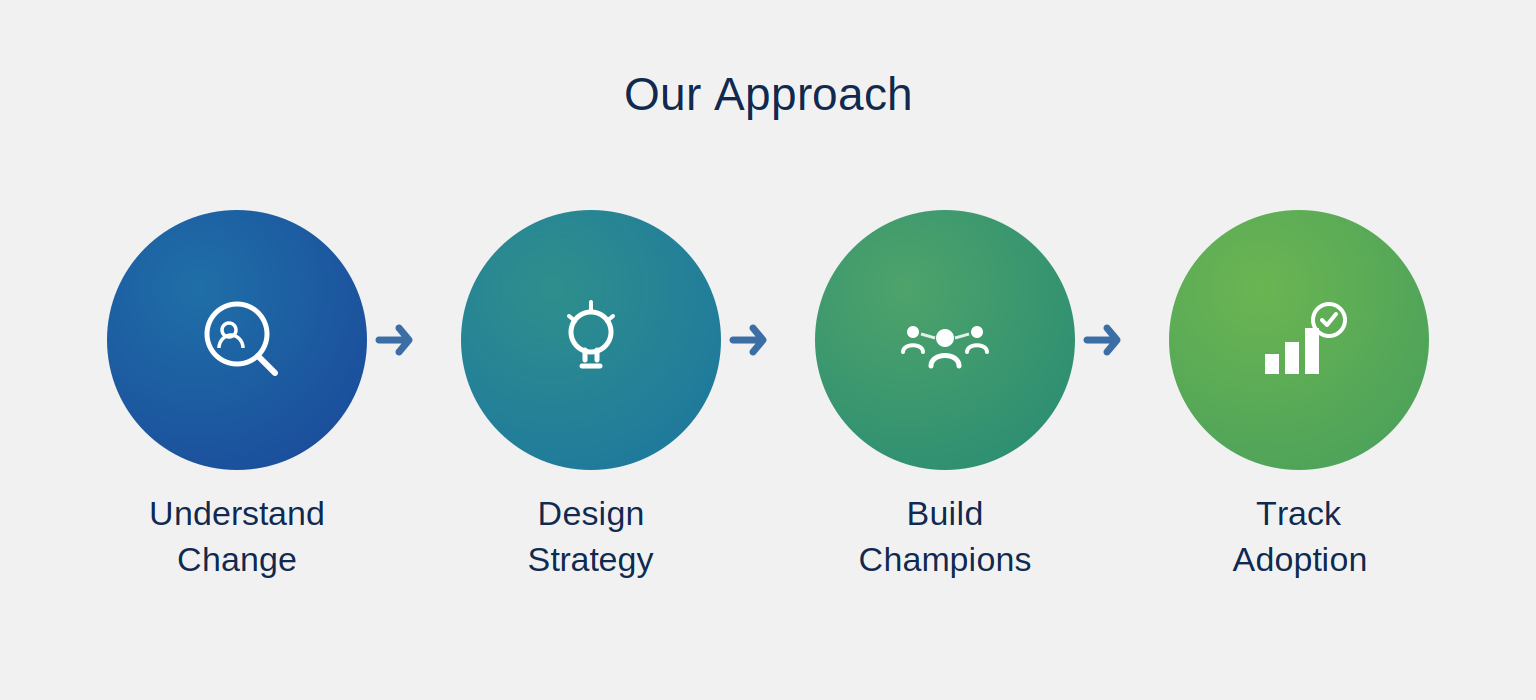
We start by understanding the specific change from the perspective of the people who have to live it, not just the leadership team commissioning it. This means understanding what is genuinely being asked of different groups, and where the friction is likely to be greatest.
From there, we design a change strategy paced to what people can realistically absorb, sequencing communication, training and support rather than front-loading everything into a single launch moment.
We build change champion networks that put trusted peers, not just senior leaders, at the centre of reinforcing new behaviour, since people generally trust colleagues doing the work more than they trust a message from far above them.
Throughout, we track adoption, not just awareness. Knowing that people have heard about a change is very different from knowing they have actually changed how they work, and we build the mechanisms to tell the difference.
From announcement to understanding. From understanding to adoption. From adoption to lasting change.
Leadership · Brief
As consolidation and economic turbulence reshape markets, the organisations that recover fastest are led by executives prepared to make hard calls under pressure.
Read more → /insights

Navigating Economic Crisis