
Training is Not Closing Capability Gaps
Learning programmes are delivered regularly, but the same capability weaknesses continue to affect performance.
How we can help
Building the essential and future capabilities organisations need through learning that translates into performance.
Learning activity does not automatically create capability. Organisations can invest heavily in training calendars, academies and development programmes while the underlying capability gaps remain largely unchanged.
The real question is not how much training has been delivered, but whether people can now do something they could not do before, and whether that improved capability is contributing to organisational performance. Effective learning requires more than a curriculum; it requires a capability architecture that connects strategy, roles, skills, learning and performance.
At Concinnity, we design capability frameworks, learning academies and essential and future skills programmes around the capabilities organisations genuinely need. We combine learning design with practical application, reinforcement and measurement so that development moves beyond knowledge acquisition and becomes visible in workplace behaviour and performance.
We help organisations move from training delivery to deliberate capability building, connecting learning investment to the skills, behaviours and performance outcomes the organisation needs.
From training activity to genuine capability. From capability to changed behaviour. From learning investment to organisational performance.
Define the capabilities required across roles, functions and levels, creating a clear architecture for understanding, developing and measuring workforce capability.
Design and deliver structured learning academies that connect development to organisational priorities, combining formal learning with practical application, coaching and reinforcement.
Build programmes that develop the human and future-facing capabilities increasingly critical to organisational performance, including communication, collaboration, problem solving and adaptability.
Identify genuine capability gaps and translate them into targeted learning journeys, curricula and development experiences tailored to specific workforce needs.
Establish measures that assess whether learning has translated into improved capability, behaviour and performance rather than relying solely on attendance or satisfaction scores.
Combine facilitated learning, digital learning, coaching, peer learning, practical application and workplace experiences to create development that continues beyond the classroom.
Assess current capability against defined requirements, creating visibility of strengths, gaps and priority areas for development across the workforce.
Training is delivered regularly, but the same capability weaknesses continue to affect performance, and success is measured through attendance rather than evidence of improved capability.
The organisation does not simply need more training. It needs a capability system connecting strategy, skills, learning and measurable performance.
Learning programmes are delivered regularly, but the same capability weaknesses continue to affect performance.
An academy or training calendar exists, but there is no clear framework showing which organisational capabilities it is designed to build.
Capabilities such as communication, collaboration, problem solving and adaptability are expected from employees but are not deliberately developed or measured.
Success is measured primarily through attendance, completion rates or satisfaction scores rather than evidence of improved capability or performance.
The organisation recognises that work is changing but has not established which skills and capabilities its workforce will need next.
People participate in learning but have limited opportunities, support or accountability to apply new skills in their day-to-day roles.
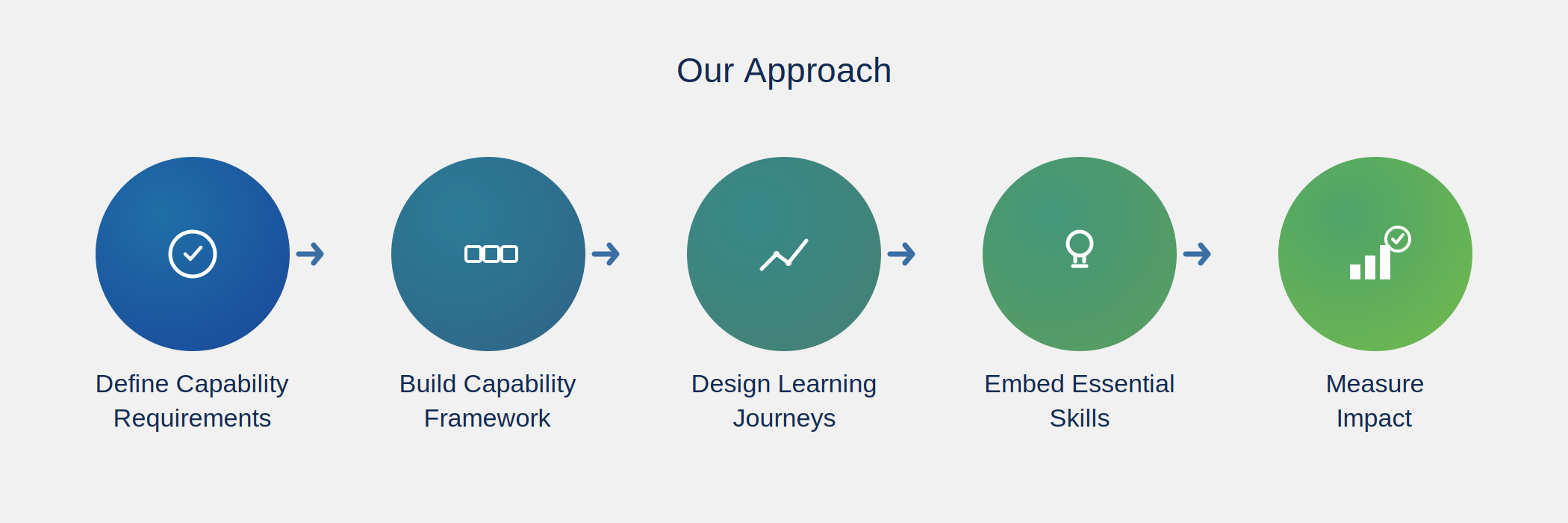
We start with organisational strategy and capability requirements, rather than with a catalogue of available courses, establishing what the organisation needs its people to be able to do and where the most important gaps lie.
We then develop a clear capability framework that defines the knowledge, skills, behaviours and levels of proficiency required across relevant roles, creating the foundation for targeted learning rather than disconnected training activity.
Learning needs are assessed against this framework and translated into prioritised learning journeys, combining formal learning, practical application, coaching, peer learning and workplace experience for each capability.
Essential and future skills are deliberately embedded into the learning architecture, ensuring organisations build the adaptability, communication and problem-solving capabilities needed as work evolves, alongside technical capability.
Finally, we establish learning impact measures from the outset, assessing whether participants have developed the intended capabilities and whether those capabilities are translating into changed behaviour and improved performance.
From training calendars to capability architecture. From learning to application. From development activity to measurable capability.
Education & Skills · Report
A global insight paper from Skills Builder Partnership and KPMG International exploring how education systems can harness AI while equipping learners with the human capabilities needed to thrive in an AI-enabled future.

Human Skills in an Age of AI