Employees are Unclear About What AI Means for Their Roles
People understand that technology is changing, but cannot clearly see how their responsibilities, workflows or career pathways will be affected.

How we can help
Workforces prepared for what AI, technology and changing work will actually demand.
The future of work is not simply a technology challenge. As AI, automation and digital technologies reshape tasks, roles and operating models, the more difficult question is how organisations prepare their people to work differently.
Technology can change faster than workforce capability. Organisations that invest in new systems without understanding the implications for roles, skills and ways of working risk creating a widening gap between what technology can enable and what their people are ready to deliver.
At Concinnity, we help organisations prepare for an evolving world of work by connecting AI and automation readiness with workforce strategy, skills, role design and change capability. We assess where technology is likely to affect work and develop practical strategies for reskilling, upskilling and workforce transition.
We help organisations move from uncertainty about the future of work to a deliberate workforce strategy for AI, automation and continuous change.
From technology adoption to workforce readiness. From reskilling to workforce agility. From preparing for disruption to building the capacity to continually adapt.
Assess workforce readiness for AI and automation, identifying affected roles, capability gaps, adoption barriers and areas where the organisation needs to build greater preparedness.
Develop targeted strategies to build the capabilities employees need as roles evolve, distinguishing between capabilities that should be developed internally and those that may need to be sourced externally.
Develop workforce strategies that anticipate changes in technology, business models and ways of working, helping organisations build the flexibility to adapt continuously.
Assess how AI and automation will change tasks and responsibilities, redesigning roles around the combination of technology and human capability rather than simply automating existing processes.
Assess employee and organisational readiness for technology-driven workforce change and establish the leadership, communication and adoption mechanisms required to support transition.
Identify the capabilities that are likely to become more important as technology changes work, creating a forward-looking view of the skills the organisation needs to build.
Develop practical transition pathways for employees whose roles are significantly affected by automation, technology adoption or changes in the operating model.
AI or automation adoption is being planned without a clear assessment of whether employees, managers and leaders are ready to work differently.
The common thread: technology is moving faster than workforce readiness, and the gap is left to resolve itself rather than being deliberately managed.
People understand that technology is changing, but cannot clearly see how their responsibilities, workflows or career pathways will be affected.
Leadership recognises the need for reskilling or upskilling, but there is no structured programme linked to specific roles and future requirements.
There is limited visibility of which roles and activities are most exposed to automation or likely to be significantly redesigned.
The organisation knows that capability requirements are changing but has not established which skills will become critical.
The organisation expects employees to adapt as technology and strategy change, but has not created the mechanisms that enable that adaptability.
New technologies have been introduced, but adoption or business impact is below expectations because workforce capability has not evolved alongside.
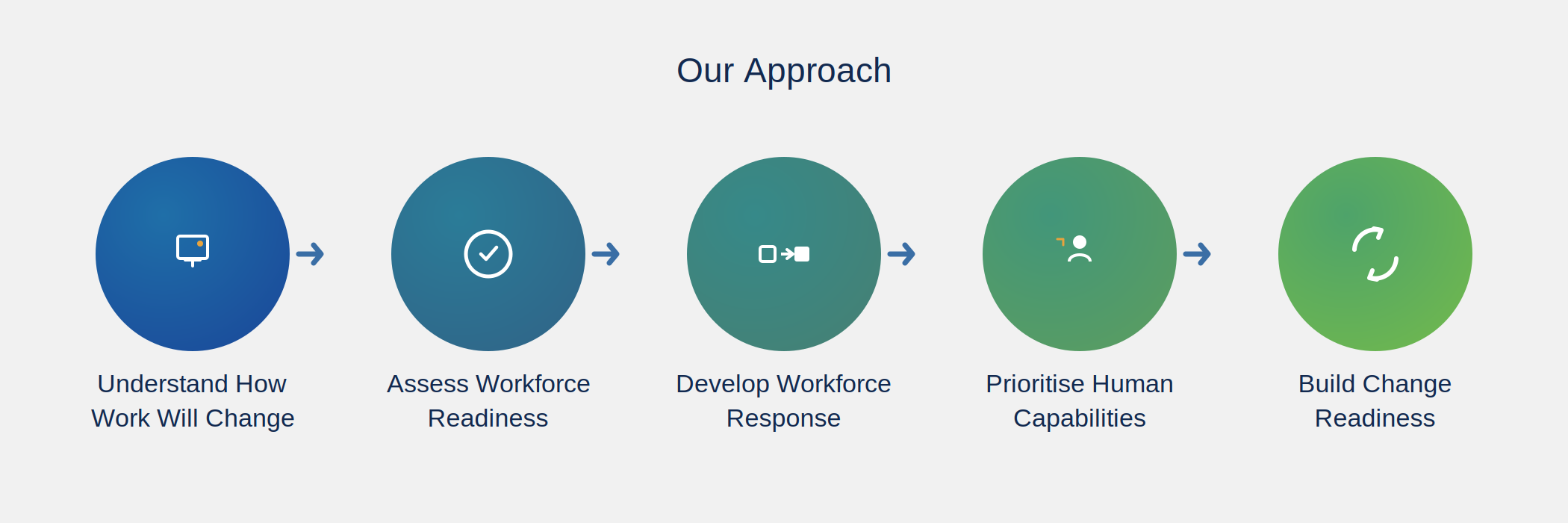
We begin by understanding how technology is likely to change the work itself, rather than starting with a list of training courses, examining the tasks and roles most likely to be affected by AI and automation.
We then assess current workforce readiness against those future requirements, identifying capability gaps, role exposure and adoption barriers, creating an evidence-based view of where intervention is most needed.
From there, we develop a targeted workforce response, which may include reskilling, upskilling, role redesign, internal mobility or other workforce transition strategies depending on the nature of the change.
We pay particular attention to the capabilities that technology is less able to replicate and that become more valuable as work changes, including adaptability, communication and judgement.
Change readiness is designed alongside the workforce response, equipping leaders and managers to explain what is changing and why, while building mechanisms for continuous learning and workforce sensing as conditions evolve.
From technology readiness to workforce readiness. From reskilling to role transformation. From adapting to change to building a workforce that can continually adapt.