Improvement Efforts Keep Treating the Symptoms
Previous interventions have produced temporary improvements but have not resolved the underlying operational, capability or structural constraint.

How we can help
Diagnosing the constraints that stand between business potential and performance.
Businesses often know that something is holding them back without being able to identify exactly what it is. Revenue may be below potential, operations may feel increasingly stretched or growth opportunities may be difficult to pursue, but the underlying constraint can remain unclear.
When the diagnosis is wrong, improvement efforts tend to address symptoms rather than causes. More people may be hired when the real issue is process design. New systems may be introduced when the constraint is management capability.
At Concinnity, we help businesses identify and address these constraints through business diagnostics, capability assessments and performance gap analysis, distinguishing between issues that are symptoms, contributing factors and genuine performance constraints.
We help businesses build a clearer understanding of what is constraining performance and what needs to change, translating diagnosis into practical priorities for improvement and growth.
The result is not simply a diagnostic report. It is a clearer understanding of what is holding the business back, what needs to change and where investment will make the greatest difference.
Conduct structured assessments of business strategy, leadership, operations, people, processes, financial management and organisational capability to establish a clear picture of current performance and readiness.
Identify the gap between current performance and desired outcomes, isolating the underlying capability, process, structural or management constraints contributing to the gap.
Translate diagnostic findings into a prioritised roadmap that defines the capabilities to strengthen, actions required, sequencing, ownership and practical measures of progress.
Strengthen the management practices, operating disciplines and organisational capabilities required to improve execution and support sustainable growth.
Provide periodic assessments of organisational health and growth readiness, helping businesses identify emerging constraints before they become material barriers to performance.
Assess the capacity of founders, owners and management teams to lead the organisation through its current stage of development and its next phase of growth.
Assess whether the business has the strategy, governance, management capability, operating systems and financial discipline required to support expansion or engage credibly with external investors and finance providers.
Enterprise development becomes urgent when leadership knows performance is below potential but cannot confidently explain why.
The common thread: the business knows performance could be stronger, but has not yet isolated the real constraint holding it back.
Previous interventions have produced temporary improvements but have not resolved the underlying operational, capability or structural constraint.
The business has expanded faster than its leadership, management systems and decision-making capacity, creating increasing operational pressure.
The business has identified a credible growth or commercial opportunity but lacks the people, processes, systems or management capability required to pursue it successfully.
Too many decisions, relationships and operational responsibilities remain concentrated with one or two individuals, limiting scalability and creating key-person dependency.
As the business has grown, processes, roles and responsibilities have become harder to manage, creating duplication, delays, errors or inconsistent customer experiences.
Management wants an objective assessment of where the business genuinely stands rather than another internal review based primarily on assumptions or perceptions.
Leadership is considering expansion, investment, new markets or increased capacity but needs confidence that the underlying enterprise is ready to support the next stage.
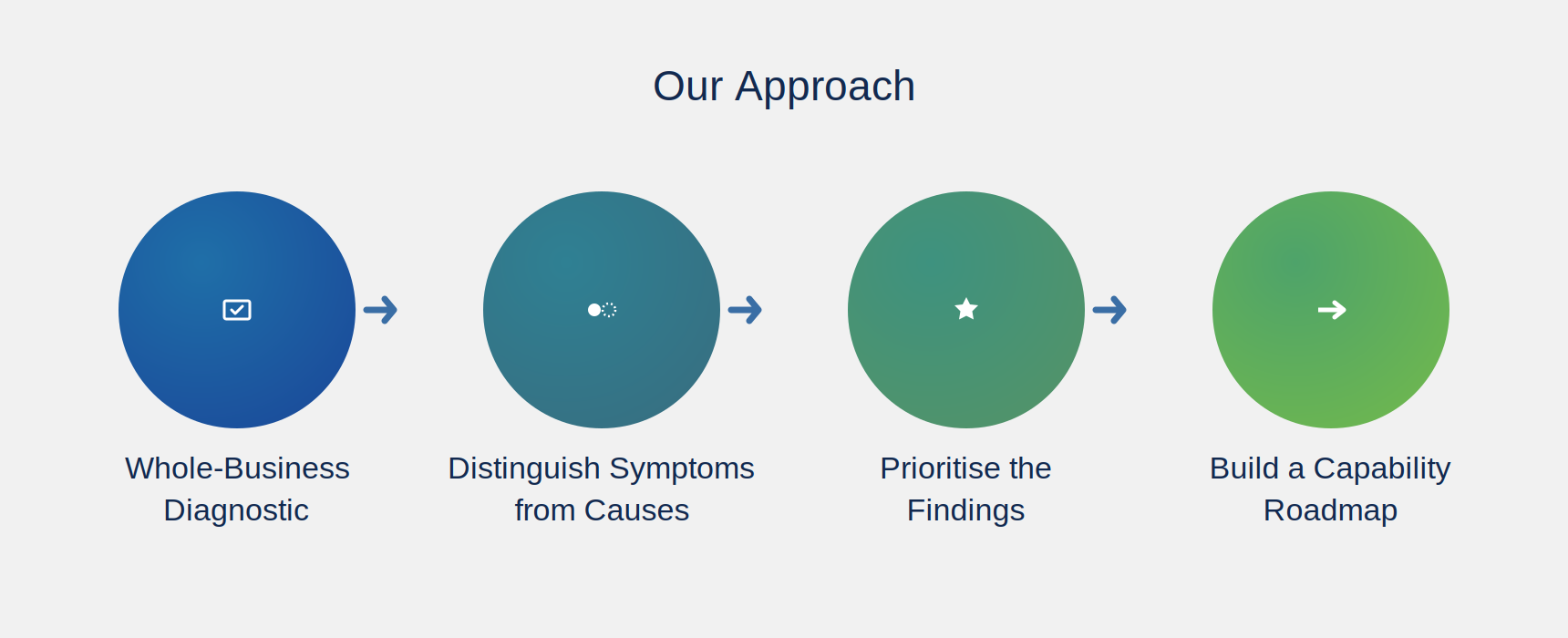
We begin with a whole-business diagnostic, examining the areas that influence enterprise performance rather than assuming the visible problem is the root cause. Our assessment considers the relationship between strategy, leadership, people, customers, operations, processes, financial management and organisational capability.
We combine structured assessment with interviews, management discussions, available performance data and, where appropriate, observation of how work actually gets done, helping us distinguish between perceived problems and evidence-based constraints.
We then prioritise the findings according to their impact on performance, urgency and ability to influence the organisation's objectives, translating diagnostic findings into a practical capability-building roadmap.
Where the business is preparing for growth or investment, we also assess organisational readiness, identifying the capabilities and management disciplines that need to be strengthened before expansion or external capital is pursued.
The objective is to ensure that improvement effort is directed where it can create the greatest value, rather than spreading investment across a long list of symptoms.