Growth Ambition Exists Without a Clear Route
Leadership has ambitious growth targets, but there is no sufficiently clear or prioritised roadmap showing how those targets will be achieved.

How we can help
Growth strategies built around real market opportunity, competitive advantage and the capacity to execute.
Ambition to grow is rarely in short supply. The harder question is where to grow, how to win and whether the organisation has the capability to deliver the growth it is pursuing.
A credible growth strategy is more than a set of revenue targets or a list of potential markets. It requires a clear understanding of where demand exists, what customers value, how competitors are positioned, where the organisation has a right to win and which opportunities can generate sustainable value.
At Concinnity, we help businesses translate growth ambition into evidence-based strategic choices and practical growth roadmaps. Our work connects market opportunity with commercial ambition and organisational readiness, ensuring that growth plans account not only for what the market could offer, but also for what the business can realistically execute.
We help businesses move from broad growth ambition to clear strategic choices, prioritised opportunities and an executable path to sustainable expansion.
The result is a growth strategy that provides clarity about where to compete, confidence about how to win and a practical path from ambition to sustainable growth.
Identify and assess attractive growth opportunities across markets, customer segments, products, services and channels, prioritising those with the strongest combination of market potential, competitive advantage and commercial value.
Translate growth priorities into a clear strategy and sequenced roadmap, defining the strategic choices, investments, capabilities and actions required to move from opportunity to execution.
Assess the resilience of the existing business model and identify opportunities to diversify revenue, customer segments, products, services or routes to market without diluting strategic focus.
Assess whether the organisation has the leadership, people, operating model, capital, systems and capabilities required to support its growth ambitions, identifying constraints before they become barriers to execution.
Facilitate focused strategic planning processes that help leadership teams make the difficult choices required at different stages of growth, creating alignment around priorities, investments and execution.
Assess market dynamics, customer needs, competitive positioning and emerging opportunities to establish where the business has a credible right to win.
Growth ambition becomes a strategic risk when it is not matched by clear, prioritised choices about where and how to compete.
The common thread: ambition exists, but the organisation has not yet made the deliberate choices that turn ambition into an executable growth path.
Leadership has ambitious growth targets, but there is no sufficiently clear or prioritised roadmap showing how those targets will be achieved.
The business has expanded successfully in the past, but growth has largely been opportunistic rather than guided by deliberate market, customer or investment choices.
Multiple growth opportunities appear attractive, but leadership teams disagree about which markets, customers, products or initiatives should receive priority.
The strategy looks compelling on paper, but the organisation has not adequately assessed whether it has the people, capital, systems, capabilities or operational capacity required to deliver it.
A significant proportion of revenue depends on a single product, customer, market, channel or contract, creating material exposure if conditions change.
Revenue and customer demand are increasing, but systems, processes, people and management capacity are struggling to keep pace.
The organisation continues to pursue new opportunities without sufficiently clear criteria for deciding what to pursue, what to defer and what to stop.
Expansion has introduced additional products, markets, customers or operating requirements, but the resulting complexity is beginning to erode margins, agility or management attention.
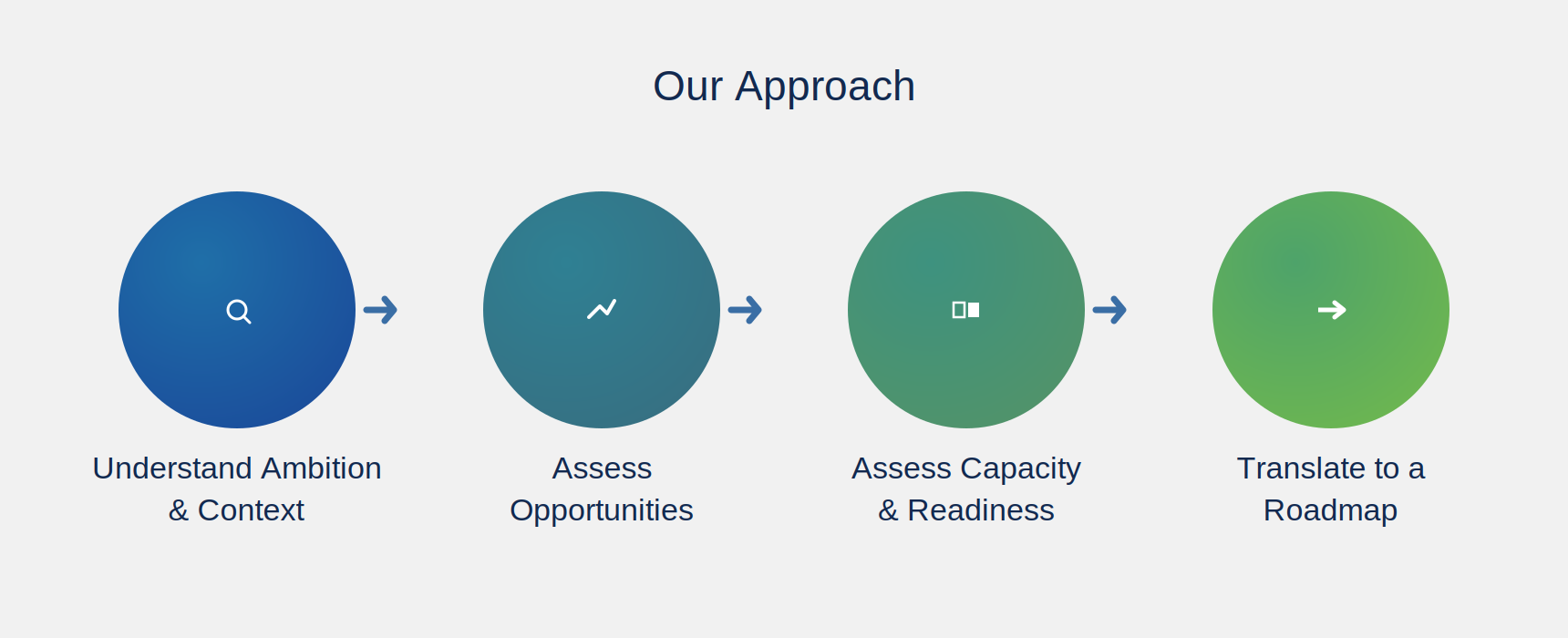
We start by establishing a clear understanding of where the business is today, where leadership wants it to go and what would need to be true for that ambition to be achieved.
We assess growth opportunities against a combination of market attractiveness, customer demand, competitive dynamics, strategic fit, commercial potential and organisational capability, distinguishing genuine opportunities from those that may look attractive but are difficult to win or execute.
We then assess the organisation's growth capacity and readiness, examining the leadership, people, operating model, technology, capital, processes and capabilities required to support expansion. Where significant constraints exist, these become part of the growth strategy rather than being left as implementation problems.
Growth options are prioritised through explicit strategic choices, then translated into a practical growth roadmap, sequencing initiatives according to value, feasibility, investment requirements, organisational readiness and strategic dependency.
The objective is not simply to produce a growth plan. It is to create a focused, evidence-based growth agenda that leadership can align behind and the organisation has a realistic capacity to execute.