Reform Has Been Announced but Not Delivered
Policy and structural changes have been approved, but service delivery on the ground remains largely unchanged.

How we can help
Strengthening institutions so public service delivery genuinely improves.
Public institutions are often asked to deliver more, with more scrutiny and fewer resources, while operating within structures, processes and capabilities built for a different era. The gap between institutional mandate and institutional capacity is where reform efforts most often stall.
Reform that focuses only on policy or structure, without addressing how the institution actually operates day to day, tends to produce change on paper rather than change in service delivery. Sustainable reform requires attention to capacity, incentives, systems and the people responsible for implementation.
At Concinnity, we help public institutions diagnose the real constraints behind underperformance and design practical reform programmes that strengthen governance, capability and service delivery, grounded in the operating realities of government and public institutions.
We help public institutions move from reform as policy intent to reform as delivered improvement in how citizens and stakeholders actually experience public services.
The objective is reform that survives beyond the programme that introduced it, embedded in how the institution actually operates.
Assess institutional performance against mandate, identifying the structural, capability, process and governance factors most responsible for underperformance.
Strengthen the leadership, management and technical capability required for the institution to deliver its mandate consistently and sustainably.
Strengthen governance structures, decision rights, oversight mechanisms and accountability systems within public institutions.
Redesign service delivery processes and standards around the outcomes citizens and stakeholders actually need, reducing complexity and improving consistency.
Assess whether institutional structures, functions and resourcing remain aligned with current mandates, and redesign them where they are not.
Support institutions through the leadership alignment, communication and staff engagement required to sustain reform beyond the initial implementation period.
Institutional reform becomes urgent when the gap between mandate and delivered performance can no longer be explained away.
The common thread: the institution's structures and capability have not kept pace with what it is now being asked to deliver.
Policy and structural changes have been approved, but service delivery on the ground remains largely unchanged.
Leadership knows performance falls short of expectations but lacks a clear, evidence-based understanding of why.
The institution has been given new or expanded responsibilities without a corresponding increase in capability, systems or resourcing.
When service delivery fails, it is difficult to identify who was responsible, what decision was made or where the process broke down.
Earlier reform efforts produced short-term improvement that faded once external support or attention moved elsewhere.
Organisational structures reflect historical arrangements rather than the institution's current priorities and ways of working.
Frontline and middle management staff can identify where processes break down, but there is no effective mechanism for that insight to inform reform.
Citizens, oversight bodies or development partners increasingly question whether the institution can deliver on its mandate.
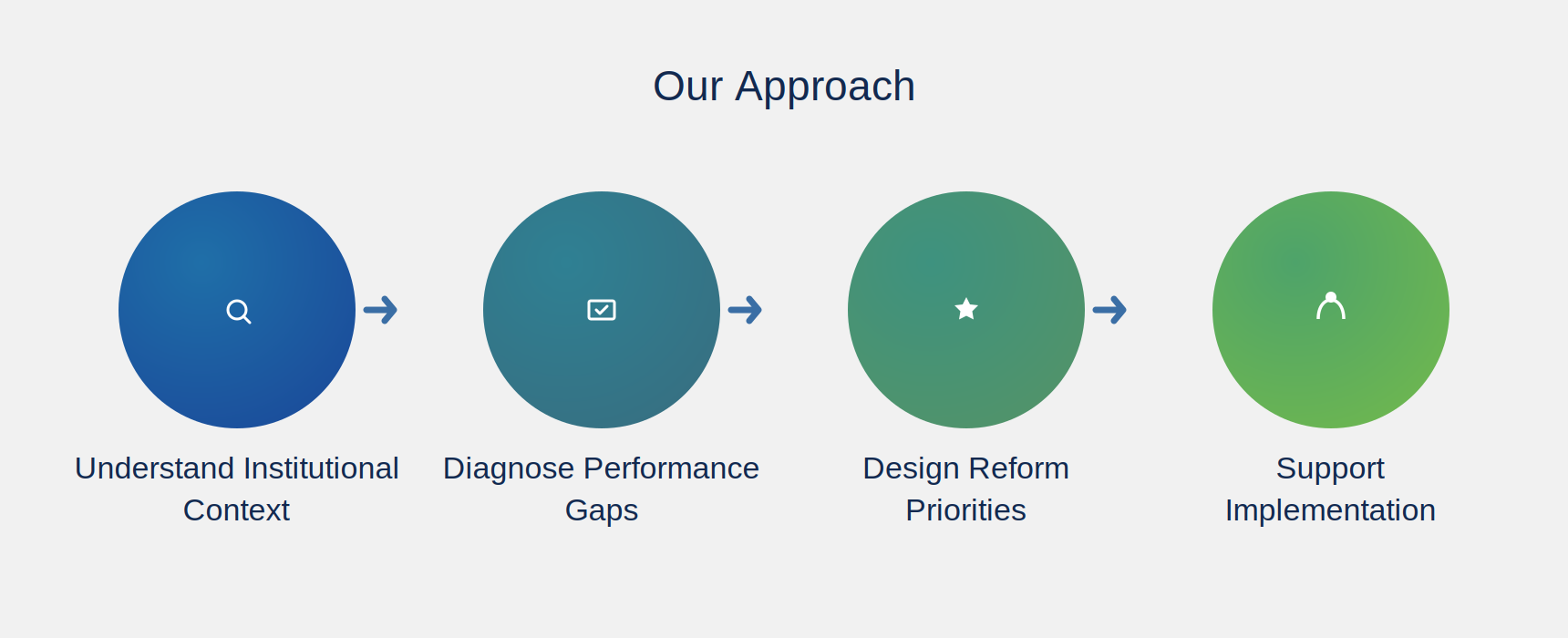
We begin by understanding the institution's mandate, operating context and the specific ways citizens and stakeholders experience its performance, rather than starting from a generic public-sector reform template.
We diagnose the gap between mandate and delivered performance, examining governance, structure, capability, systems and incentives to identify the constraints that matter most, distinguishing genuine capacity gaps from issues that are more structural or political in nature.
From this diagnosis, we design reform priorities that are realistic given the institution's resourcing and political context, sequencing change so that early wins build credibility for more difficult structural reforms.
We support implementation directly, working alongside institutional leadership and staff to build the capability required to sustain reform, since reform designed without the people who must deliver it rarely survives contact with implementation.
The result is reform grounded in the institution's actual operating reality, with the capability and accountability required to sustain improved service delivery over time.