M&E Exists Primarily for Donor Reporting
Data is collected and reported because the funding agreement requires it, with limited connection to how the programme team actually makes decisions.

How we can help
Turning programme data into evidence that improves delivery.
Monitoring and evaluation is often treated as a compliance requirement: data collected to satisfy a donor report rather than to genuinely inform how a programme is being delivered. When this happens, M&E systems can consume significant resources while contributing little to actual programme performance.
Effective M&E is designed around the decisions a programme needs to make, not simply the indicators a funding agreement requires. It generates evidence that programme managers can act on, in time for that evidence to matter.
At Concinnity, we design monitoring, evaluation and learning systems that are genuinely useful to programme delivery, connecting measurement to decision-making and building the organisational habits required to learn from evidence rather than simply report it.
We help organisations build M&E and learning systems that inform real decisions, not just compliance reporting.
The objective is an M&E system that programme teams actually use, because it answers the questions that matter to how the programme is run.
Design results frameworks and indicators that genuinely measure programme progress and are realistic to collect given the operating context.
Design practical data collection, management and reporting systems appropriate to the programme's scale, resourcing and technical capacity.
Design and conduct baseline, midline, endline and thematic evaluations that generate credible evidence about programme performance and impact.
Establish structured learning processes that translate monitoring and evaluation evidence into programme adjustments during implementation.
Strengthen data collection practices, verification processes and quality assurance systems to improve the reliability of programme evidence.
Build the M&E capability of programme teams and partner organisations so that measurement and learning become embedded institutional practice.
Translate M&E evidence into clear reporting for funders, governance bodies and other stakeholders that goes beyond activity counts to genuine performance insight.
M&E becomes a wasted investment when data is collected diligently but never genuinely informs how the programme is managed.
The common thread: the organisation is investing in measurement without a clear route from evidence to decision.
Data is collected and reported because the funding agreement requires it, with limited connection to how the programme team actually makes decisions.
The indicators being tracked are easy to measure but only loosely connected to the outcomes the programme genuinely cares about.
Evaluations are conducted, but findings are delivered after the decisions they could have informed have already been made.
Frontline staff and programme managers have limited confidence in the accuracy or completeness of the data being reported upward.
The organisation has no structured process for reviewing evidence and adjusting the programme's approach during implementation.
Monitoring and evaluation depends heavily on one specialist, with limited capability elsewhere in the programme team to use or interpret data.
Programme reporting focuses on what was done and how many people were reached, rather than what actually changed as a result.
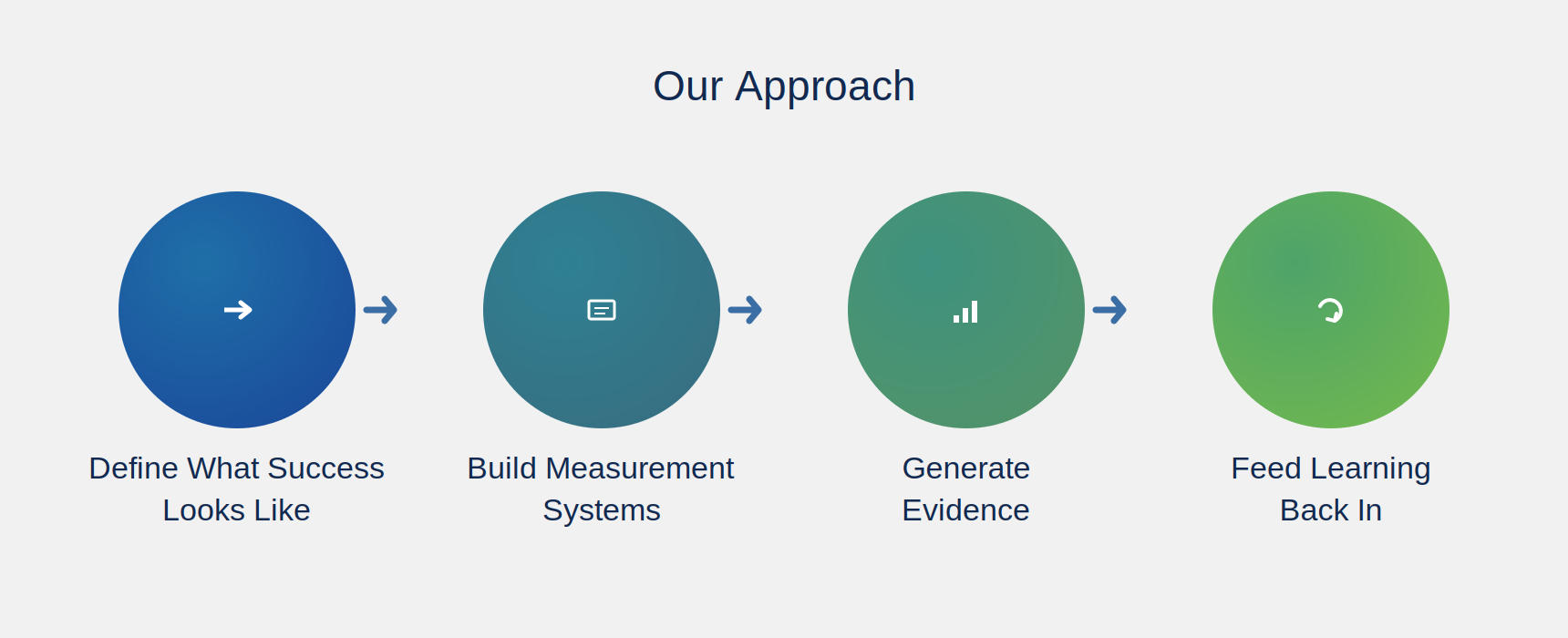
We begin by clarifying what success genuinely looks like for the programme and which decisions the M&E system needs to inform, rather than starting from a generic indicator list.
We then design measurement systems that are realistic given the programme's operating context, balancing rigour with the practical constraints of data collection in the field.
Evidence generation is built around credible evaluation design and reliable data quality processes, since evidence that cannot be trusted cannot meaningfully inform decisions.
Throughout, we focus on feeding learning back into delivery, establishing the review routines and decision processes required for evidence to actually change how the programme operates, not simply how it is reported.
The result is an M&E system that strengthens programme delivery in real time, rather than one that exists solely to satisfy an external reporting requirement.