Activities Are Clear but the Change Logic Is Not
The programme document describes what will be done in detail but cannot clearly explain why those activities will produce the intended outcomes.

How we can help
Designing and delivering development programmes that translate intent into results.
Development programmes are frequently designed around available funding, established templates or donor expectations, rather than a clear and tested theory of how change will actually happen. The result can be a programme that is well resourced and well intentioned, yet struggles to demonstrate that it is changing anything.
Effective programme design starts with a rigorous understanding of the problem being addressed and works backwards to determine what combination of activities, partnerships and resources could plausibly produce the intended change, then builds in the management systems required to deliver it.
At Concinnity, we help governments, development partners and implementing organisations design and manage programmes that are theoretically sound, operationally realistic and built to adapt as implementation reveals what is and is not working.
We help organisations design programmes with a credible theory of change and the delivery systems needed to translate design into results.
The objective is a programme that is not just fundable and well documented, but genuinely capable of producing the change it sets out to achieve.
Develop rigorous, evidence-based theories of change that articulate how proposed activities will plausibly lead to intended outcomes and impact.
Translate programme strategy into practical architecture, including components, activities, outputs, outcomes, indicators and delivery structures.
Establish the management systems, governance structures, work planning and delivery routines required to implement programmes effectively at scale.
Identify programme risks and build in the structures and decision processes required to adapt delivery as implementation reveals new evidence.
Coordinate delivery across government agencies, implementing partners, communities and other stakeholders with different mandates, incentives and capacities.
Align programme budgets and resource allocation with strategic priorities, ensuring resources are directed to the activities most likely to produce intended results.
Programme design becomes a genuine risk when activities are well defined but the connection to intended change is not.
The common thread: significant resources are being committed to a set of activities whose connection to genuine change has not been rigorously tested.
The programme document describes what will be done in detail but cannot clearly explain why those activities will produce the intended outcomes.
The scope and focus of the programme were shaped more by what a funding opportunity required than by a rigorous assessment of the problem.
Early implementation experience suggests that the assumptions underlying the programme design do not hold in practice.
Multiple implementing partners or government agencies are involved, but roles, responsibilities and decision rights are not sufficiently clear.
Emerging evidence suggests a change in approach is needed, but there is no efficient mechanism for adapting the programme design mid-implementation.
The programme has grown in scope or reach, but management systems, staffing and governance have not scaled accordingly.
Resource allocation follows historical patterns or convenience rather than a clear view of which activities matter most to achieving results.
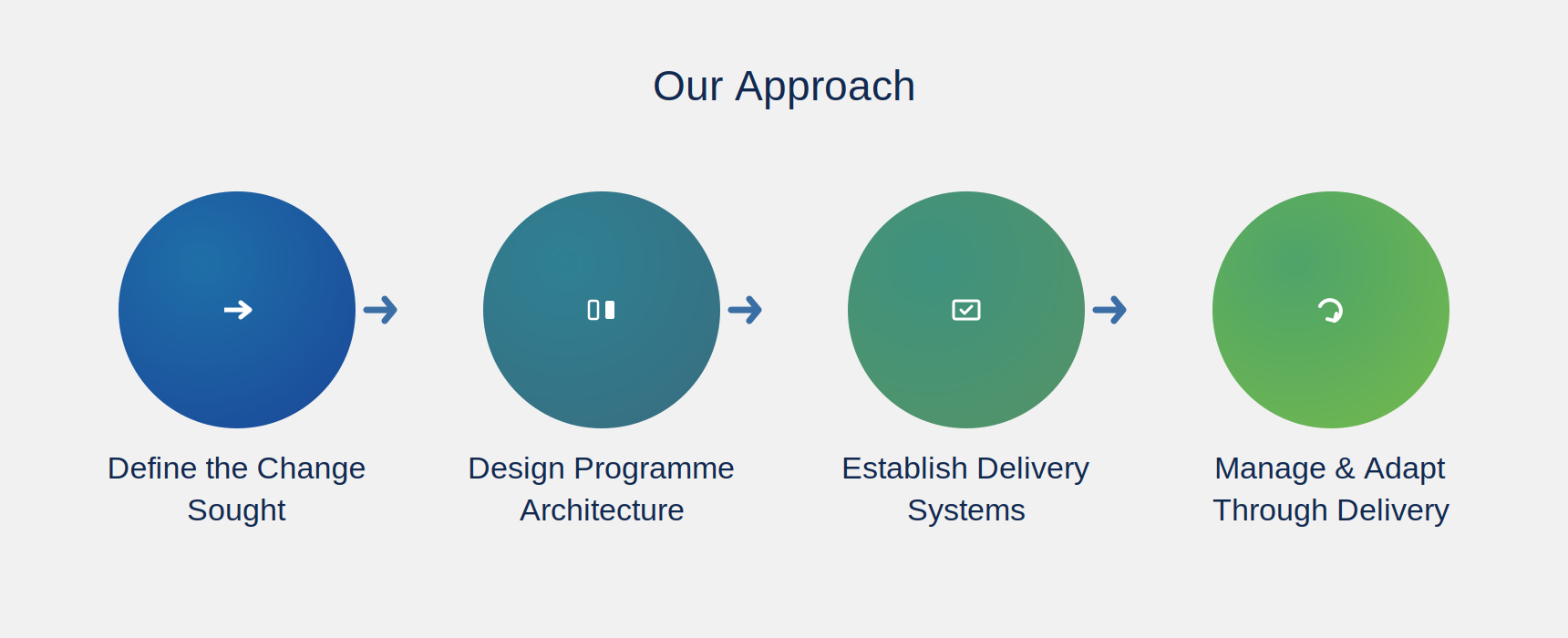
We start by defining the change the programme is genuinely trying to achieve, working with stakeholders to build a theory of change that is specific, plausible and testable, rather than accepting a generic results framework inherited from a funding template.
We then design the programme architecture: the components, activities, delivery structures, partnerships and resourcing required to translate the theory of change into an implementable plan.
We establish the delivery systems the programme needs to function well in practice, including governance, work planning, coordination mechanisms and management routines appropriate to the programme's scale and complexity.
Throughout implementation, we help programmes build in adaptive management, ensuring that emerging evidence about what is and is not working can genuinely inform how the programme evolves, rather than being generated too late or without a mechanism for acting on it.
The result is a programme built to deliver results, not simply to comply with a design template, with the management discipline to adapt as real-world implementation unfolds.