Citizens Describe the Service as Unreliable
A digitised government service has launched but citizens still describe it as unreliable or confusing.

How we can help
Government services modernised without losing citizen trust.
Public sector digital transformation carries a burden private sector technology projects do not: citizens who have little choice but to use the service, and whose trust, once lost to a poorly executed digitisation effort, is difficult to rebuild. Modernisation has to earn that trust, not simply assume it.
Digital government initiatives can carry strong political backing while resting on weak institutional foundations, a combination that tends to produce a system that launches with fanfare but struggles to sustain citizen confidence.
At Concinnity, we help governments modernise services and improve institutional effectiveness, designing digital transformation that citizens experience as a genuine improvement, not just a new interface on an old process.
We help governments design digital transformation around the citizen's actual experience of the service, building the institutional foundations required to sustain it.
The result is digital government transformation that citizens experience as a genuine improvement, sustained by institutions ready to deliver it.
Develop digital government strategies and roadmaps that connect technology investment to genuine improvements in citizen experience and institutional effectiveness.
Design and digitise government services around what citizens actually need, not simply a digital replica of the existing process.
Address data governance and interoperability between government systems early, since fragmented systems are usually where digitised government services quietly fail citizens.
Advise on digital identity and service delivery platforms, helping institutions choose and implement solutions appropriate to their context and capacity.
Assess institutional readiness honestly before committing to a digital transformation roadmap, since political backing alone is not sufficient to sustain delivery.
When government digitisation has strong ambition, but citizen trust and institutional readiness have not kept pace.
The common thread: the political will to modernise exists, but the institutional readiness to sustain that modernisation has not been honestly assessed.
A digitised government service has launched but citizens still describe it as unreliable or confusing.
Different government systems cannot share data with each other despite serving related functions.
Digital transformation is being pursued without an assessment of institutional readiness to sustain it.
Citizens have lost confidence in a service following a difficult digitisation experience.
A digital government initiative has strong political backing but weak institutional foundations.
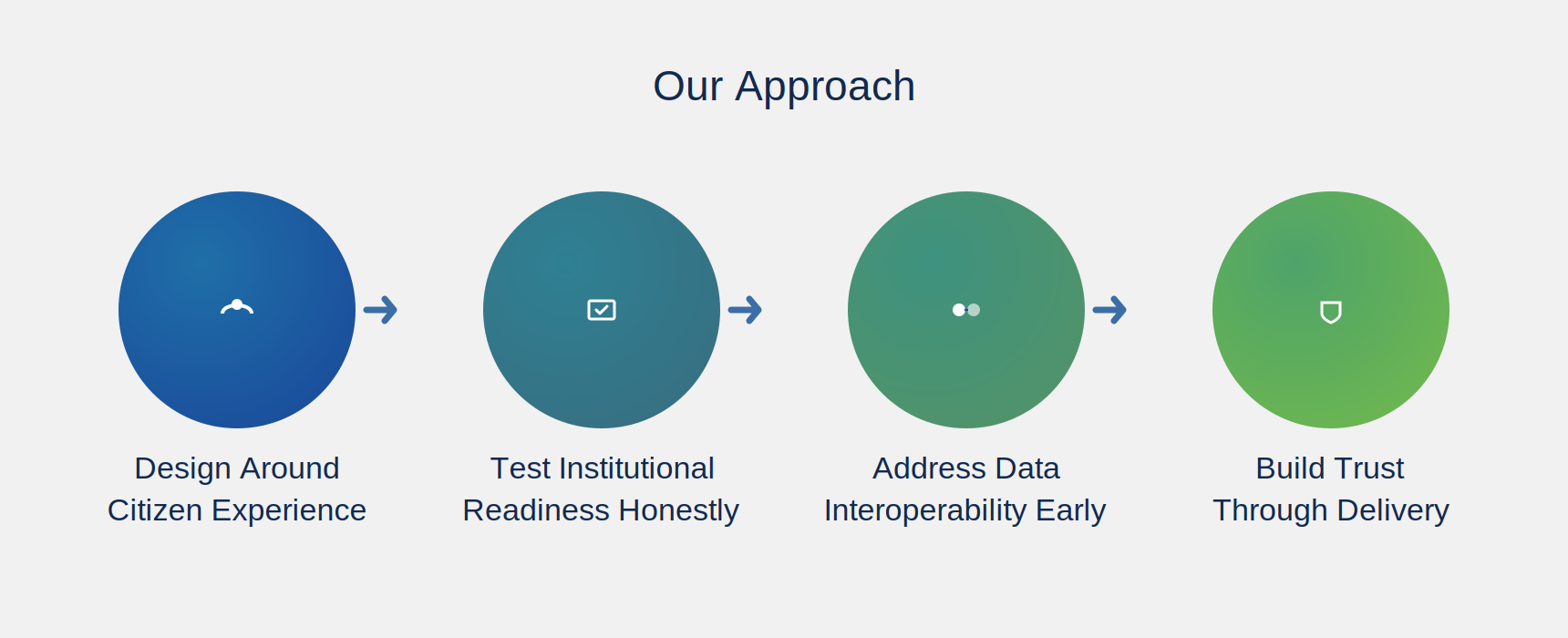
We design public sector digital transformation around the citizen's actual experience of the service, not just the technical migration from one system to another.
We test institutional readiness honestly before committing to a roadmap, since political backing alone cannot substitute for the institutional capacity required to deliver and sustain transformation.
Data governance and interoperability are addressed early, since fragmented systems are usually where digitised government services quietly fail citizens, even when the front-end interface looks polished.
Throughout delivery, we focus on building the trust citizens place in the service, recognising that trust lost to a poor digitisation experience is difficult to rebuild.
The result is digital government transformation that citizens experience as a genuine improvement, built on institutional readiness rather than political ambition alone.