Dashboards Without Trust
Dashboards exist across the organisation but leadership still relies on instinct for major decisions.

How we can help
Data turned into strategic insight, not just dashboards nobody reads.
Most organisations have more data than they use and less governance than they need, which means dashboards proliferate while genuine insight remains scarce. Strategic value comes from disciplined governance and analytics design, not simply from having more data available.
Without clear governance, different parts of the organisation can report inconsistent numbers for what should be the same metric, and leadership can lose confidence in which dataset to actually trust when making a decision.
At Concinnity, we transform data into strategic insight through governance, dashboards and analytics, building the discipline that turns raw data into decisions leadership actually trusts.
We help organisations build the governance and analytics capability required to turn data into insight leadership genuinely relies on.
The result is analytics leadership trusts enough to actually use, built on data governance strong enough to sustain it.
Design the policies, ownership and standards required to give the organisation a single, trusted view of its own data.
Design and build dashboards and reporting that translate data into clear, decision-ready insight rather than raw numbers.
Apply analytics and predictive modelling to answer specific business questions, connected to decisions the organisation actually needs to make.
Strengthen data quality and integration across systems so that analytics and reporting are built on data that can be trusted.
Build the organisation's own analytics capability alongside the deliverable, so insight generation does not remain dependent on an external partner.
When dashboards exist across the organisation, but leadership still relies on instinct for the decisions that matter most.
The common thread: the organisation has invested in analytics tools before investing in the data governance those tools depend on.
Dashboards exist across the organisation but leadership still relies on instinct for major decisions.
Different departments report inconsistent numbers for what should be the same metric.
Data governance is unclear, so nobody is confident which dataset is the authoritative one.
Analytics investment has been made but the organisation lacks the internal capability to sustain it.
Data quality issues are discovered downstream, after they have already affected a decision.
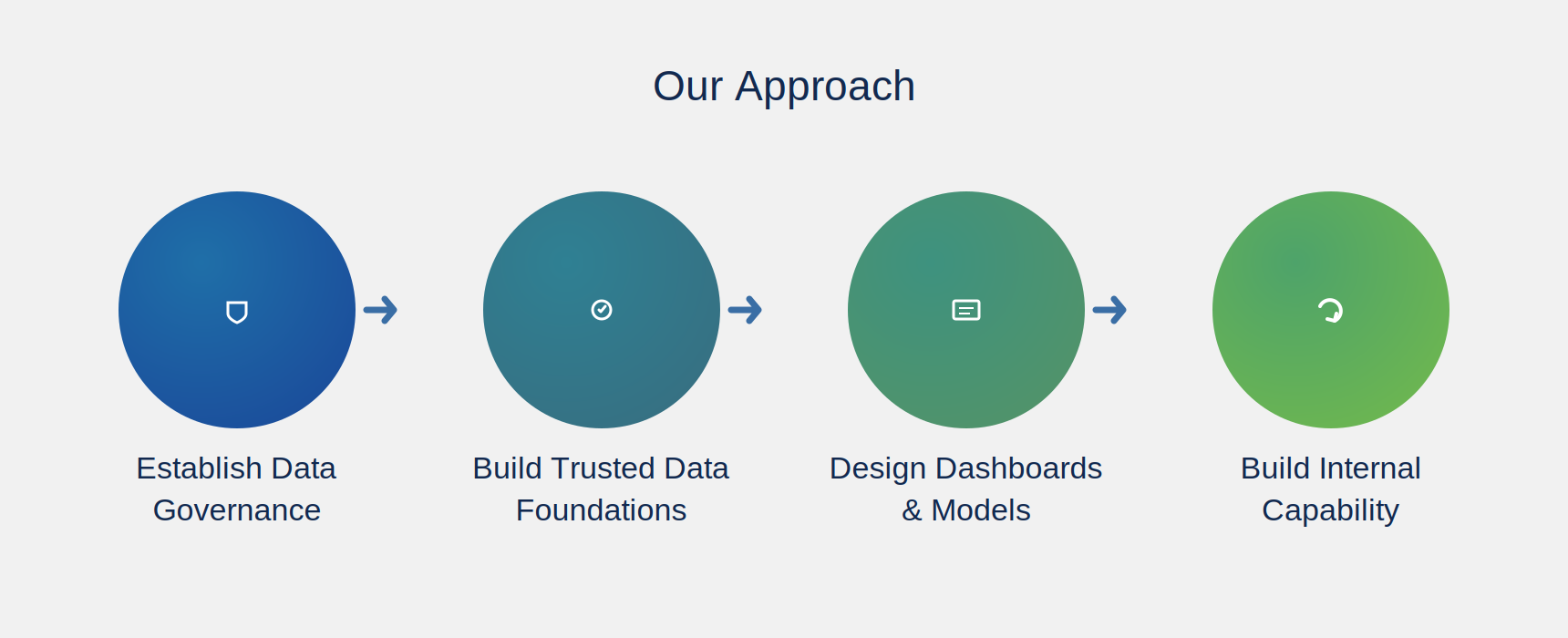
We start by establishing data governance, defining ownership, standards and accountability so the organisation has a single, trusted view of its own data rather than competing versions across departments.
We build data governance and analytics capability together, so dashboards and models sit on data leadership can actually trust rather than data assumed to be correct.
From this foundation, we design dashboards and analytical models around the specific decisions the business needs to make, rather than producing generic reporting that goes unused.
Wherever possible, we build the organisation's own analytics capability alongside the deliverable, so insight generation does not remain dependent on an external partner once the engagement ends.
The result is analytics the organisation can sustain on its own, built on a data foundation leadership trusts enough to act on.