When automation has been introduced, but the underlying inefficiency it was meant to solve is still there.
Automation Without Improvement: A process has been automated, but the underlying inefficiency is still there, just faster.

How we can help
Efficiency built by redesigning the process, not just automating it.
Automating a broken process makes it fail faster, not better. Genuine efficiency gains come from redesigning how work flows before introducing the technology meant to accelerate it, so automation amplifies a good process rather than entrenching a poor one.
Many automation initiatives are approached the other way round: technology is applied to a process as it currently exists, preserving whatever duplication, delay or unnecessary complexity was already there, simply executed more quickly.
At Concinnity, we improve efficiency through technology-enabled process redesign and automation, redesigning the underlying process first so automation delivers the gains it promises.
We help organisations pair process redesign with automation, so technology investment produces a genuinely faster and simpler way of working, not just a faster version of the same problems.
The result is automation that amplifies a genuinely improved process, rather than technology layered over problems that remain unresolved.
Assess how work actually flows today and redesign processes to remove duplication, delay and unnecessary complexity before automation is introduced.
Design and implement automation for repetitive, rules-based tasks, applied to processes that have already been simplified so the technology delivers its full value.
Develop a clear strategy for which processes to digitise, in what sequence and with what technology, connected to genuine business priorities.
Assess automation opportunities against effort, cost and expected benefit, building a clear business case before investment is committed.
Track whether automated processes are actually delivering the efficiency, accuracy and cost benefits the business case promised.
The common thread: automation has been treated as a technology decision rather than a process decision, and the process was never fixed first.
Automation Without Improvement: A process has been automated, but the underlying inefficiency is still there, just faster.
Staff spend significant time on manual, repetitive tasks that could plausibly be automated.
Automation initiatives have stalled without a clear business case behind them.
Different teams have automated similar tasks in inconsistent, uncoordinated ways.
Nobody is tracking whether a past automation investment actually delivered the efficiency promised.
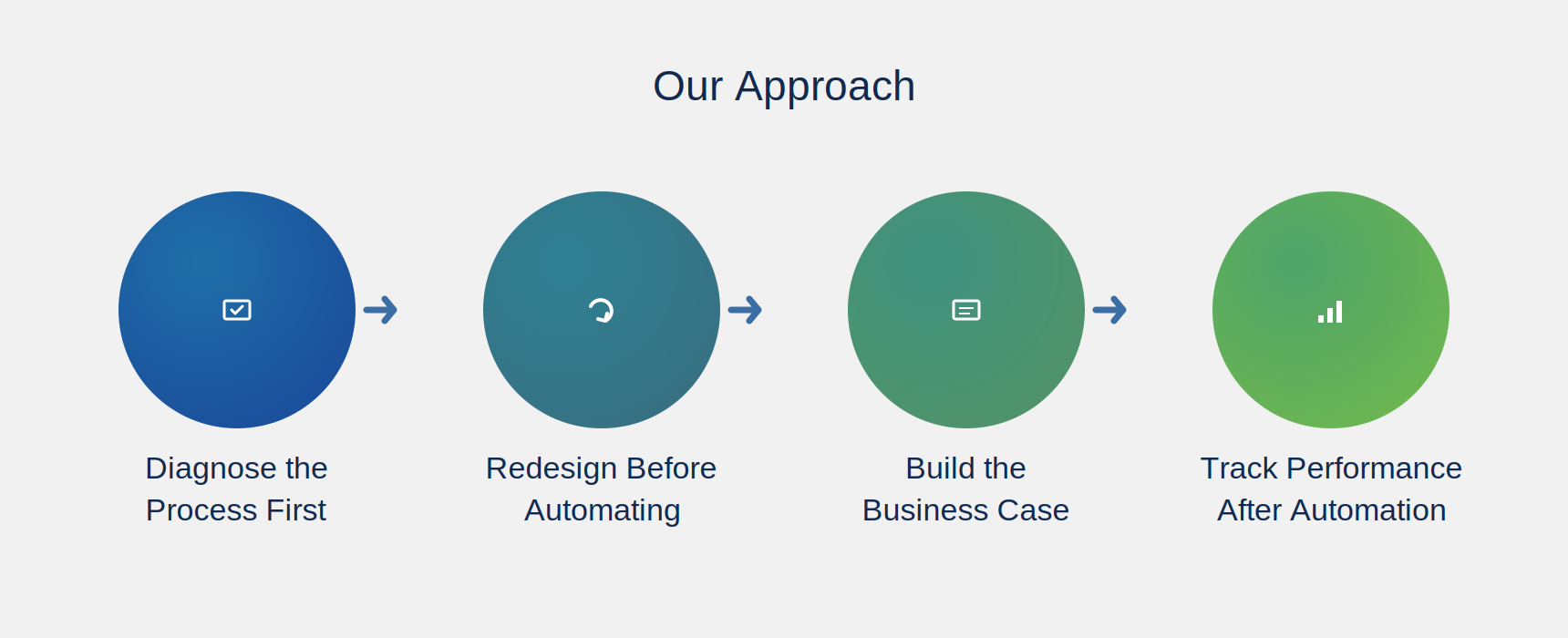
We begin by understanding how the process actually works today, mapping the real flow of work rather than the process as it is documented on paper, since the two frequently diverge.
We redesign the underlying business process before recommending automation, so the technology accelerates a genuinely improved way of working rather than a flawed one.
Automation opportunities are then prioritised by a clear business case, weighing effort, cost and expected benefit, so investment is directed towards the processes where automation will create the most value.
Performance is tracked after implementation to confirm the efficiency gain was actually realised, since a process that looks improved on paper needs to be verified against what actually changed in practice.
The result is automation that delivers the efficiency it promised, built on a process that was genuinely fixed first.