The Partnership Launched Well but Momentum Has Faded
Initial enthusiasm and early activity have not translated into sustained, coordinated delivery.

How we can help
Convening the partnerships that build skills for the economy at scale.
The skills gap facing many economies is too large for any single institution to close alone. Closing it at scale requires coordinated action across government, employers, education providers and skills bodies, each contributing what they are best positioned to provide.
These partnerships are difficult to sustain. Different institutions bring different mandates, timelines and incentives, and partnerships that start with genuine enthusiasm can struggle once the practical work of alignment, governance and sustained delivery begins.
At Concinnity, we help design, convene and govern skills and workforce development partnerships that connect national frameworks with employer needs and education delivery, translating shared ambition into coordinated, sustained action.
We help institutions build the partnerships, frameworks and governance required to close skills gaps at a scale no single organisation could achieve alone.
The objective is a skills partnership that survives the transition from launch enthusiasm to the sustained coordination genuine impact requires.
Align skills programmes and interventions with national skills frameworks, qualifications systems and workforce development priorities.
Design the structures and mechanisms required to engage employers meaningfully in skills partnerships, ensuring training remains connected to genuine labour market demand.
Align curricula, training standards and assessment approaches with the skills requirements employers and the broader economy actually need.
Design the governance structures, decision rights and coordination mechanisms required to sustain multi-institutional skills partnerships over time.
Design skills partnership programmes that translate national or sectoral skills priorities into implementable delivery models.
Help institutions anticipate future workforce and skills requirements, connecting current skills investment to longer-term economic and labour market change.
Skills partnerships lose momentum when shared ambition is not matched by the coordination needed to sustain joint delivery.
The common thread: the ambition for coordinated action exists, but the governance and delivery discipline required to sustain it has not yet been built.
Initial enthusiasm and early activity have not translated into sustained, coordinated delivery.
Employer involvement is largely symbolic, with limited influence over curriculum, standards or programme design.
Skills programmes continue to train people in areas with limited employer demand, while genuine skills gaps remain unaddressed.
Multiple institutions are involved, but decision rights, accountability and coordination mechanisms were never formally agreed.
Government, education providers and employers each have a different view of what the partnership should prioritise, and this has never been explicitly resolved.
Progress relies heavily on the personal commitment of a few individuals, creating risk if those individuals move on or lose capacity.
The partnership has produced valuable pilots or case studies but has not found a credible path to scale.
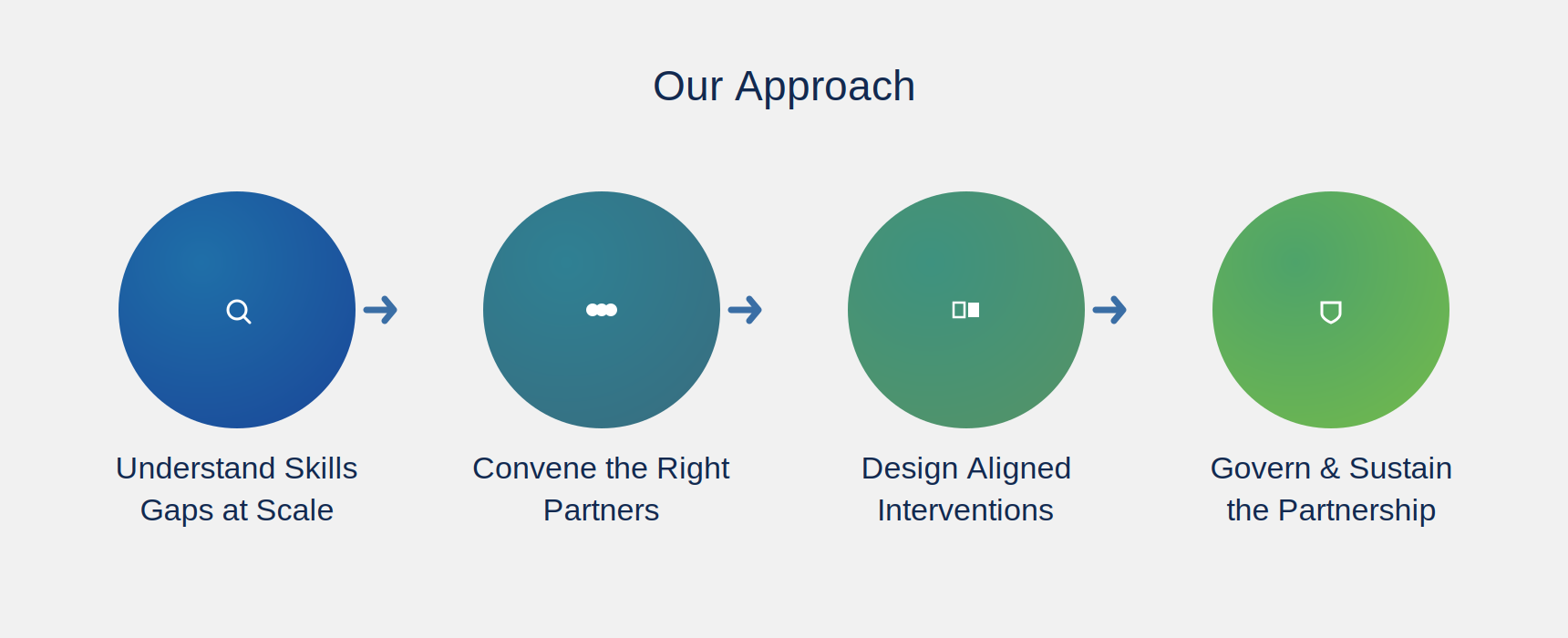
We begin by understanding the scale and nature of the skills gap the partnership is intended to address, and the labour market evidence behind it, so the partnership is built around genuine demand rather than assumption.
We help convene the right partners, since a skills partnership is only as effective as the institutions and employers genuinely committed to it, and bring clarity to what each partner is expected to contribute.
We then design interventions that align curriculum, standards and delivery models with employer needs and national skills frameworks, translating shared ambition into a practical delivery plan.
Finally, we help establish the governance structures required to sustain the partnership, including decision rights, coordination mechanisms and accountability, so that delivery continues beyond the initial period of momentum.
The result is a skills partnership built to last, with the governance discipline and employer alignment required to close skills gaps at genuine scale.