
Enterprise Support is Not Translating into Jobs at Scale
Individual businesses may be improving, but the programme has no clear evidence that these improvements are creating additional employment or wider economic opportunity.

How we can help
Designing the enterprise ecosystems, programmes and interventions that turn economic opportunity into jobs and inclusive growth.
Economic growth does not automatically translate into broad-based opportunity. Governments and development finance institutions seeking to create jobs, strengthen local enterprise and expand economic participation face a more complex challenge than improving the performance of individual businesses.
At Concinnity, we help governments, development finance institutions and development partners design and strengthen interventions that stimulate enterprise growth, job creation, productivity and inclusive economic participation.
We also recognise that economic participation extends beyond formal high-growth enterprises. Indigenous, traditional and informal enterprises can play a significant role in livelihoods, local economies and community resilience, and we incorporate these businesses into economic-development strategies rather than treating them as peripheral to the growth agenda.
We support governments, DFIs and development partners to translate economic-development priorities into scalable, measurable and inclusive enterprise interventions.
The result is development intervention designed not simply to distribute support, but to strengthen the economic mechanisms through which enterprises grow and opportunity is created.
Design enterprise-development programmes for governments, DFIs and development partners, connecting interventions to clear economic outcomes and measurable pathways to growth.
Develop strategies that connect enterprise growth with employment, income generation and broader participation in economic opportunity.
Identify priority sectors and value chains with the potential to generate enterprise growth, productivity improvements, employment and wider economic value.
Design targeted interventions that address specific constraints to enterprise growth, including market access, finance, productivity, skills and business capability.
Develop approaches that strengthen indigenous, traditional and community-based enterprises while recognising their contribution to livelihoods, local economies and inclusive growth.
Strengthen the institutions, markets, networks and support mechanisms that enable entrepreneurs and MSMEs to start, survive and grow.
Help DFIs and other financing institutions align financial instruments and enterprise-support mechanisms with the actual constraints facing target businesses and sectors.
Develop monitoring and evaluation frameworks that demonstrate whether enterprise interventions are translating into meaningful changes in business performance, employment, income and inclusion.
Establish mechanisms for using implementation evidence to refine programmes, redirect resources and improve impact over time.
Economic development interventions lose impact when enterprise support is not clearly connected to jobs, inclusion and measurable economic outcomes.
The common thread: enterprise support is active, but its connection to jobs, inclusion and measurable economic outcomes has not been clearly established.
Individual businesses may be improving, but the programme has no clear evidence that these improvements are creating additional employment or wider economic opportunity.
Activities and outputs are defined, but there is no credible explanation of how the intervention will translate into enterprise growth, productivity, jobs or inclusion.
Businesses may receive support, yet the structural constraints affecting the wider sector or value chain remain unchanged.
Inclusion is referenced in policy or programme objectives but has not been translated into specific target groups, mechanisms, interventions or measurable outcomes.
Economic-development strategies focus predominantly on formal or high-growth businesses while overlooking enterprises that sustain significant local livelihoods and economic activity.
Demand may exist, but productivity, finance, skills, infrastructure, standards, market access or institutional weaknesses prevent enterprises from capturing the opportunity.
A programme reaches many beneficiaries but lacks a robust framework for demonstrating whether those businesses actually became stronger, created jobs or generated additional economic value.
Government agencies, DFIs and development partners are investing in enterprise development but programmes overlap, leave gaps or operate without a shared view of the wider enterprise ecosystem.
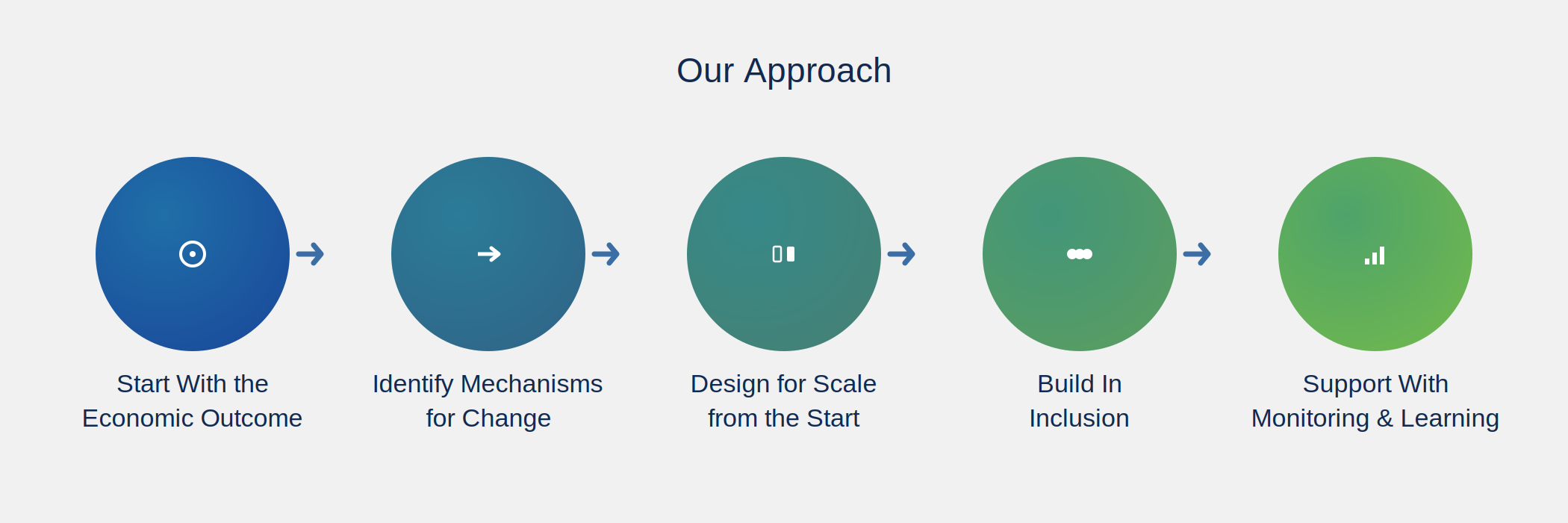
We begin with the economic outcome rather than the intervention, establishing what the intervention is intended to change: enterprise formation, survival, productivity, revenue, investment, employment, income, market participation or another clearly defined economic outcome.
We then identify the mechanisms that can realistically produce that change, which may involve addressing access to finance, business capability, skills, market access, value-chain constraints or institutional weaknesses.
The intervention is designed around a clear theory of change and results architecture, connecting activities to outputs, enterprise-level outcomes and ultimately wider economic impact.
Inclusion is built into the design rather than added retrospectively. We identify which groups, enterprises, regions or economic actors may be excluded from conventional growth mechanisms and design appropriate pathways for participation.
Implementation is supported by robust monitoring and learning, establishing the evidence required to determine what is working, for whom and at what cost, enabling programmes to adapt rather than continuing to fund activities simply because they were included in the original design.
Our goal is to help institutions move from enterprise support as a collection of activities to enterprise development as a deliberate engine of economic growth.
Community Development · Research

Concinnity's research into Nigeria's Adire textile industry explores how intellectual property protection can safeguard traditional cultural expressions while s...