
Protecting Indigenous Heritage
Concinnity Solutions Watch

Safeguarding Nigeria’s Creative Economy
The Concinnity Solutions Watch is our periodic business whitepaper that spotlights pressing societal challenges and emerging opportunities across Nigeria’s economic and social landscape. It serves both as a platform for inquiry and a tool for action, providing evidence-based insights, practical solutions and pathways for co-creating innovative and impactful strategies.
This edition’s theme draws on emerging insights from a recent SME Advisory Training Programme, where participants critically examined the potential of leveraging intellectual property as collateral to strengthen Nigeria’s creative economy. This conversation inspired this subject of quarter’s edition of Concinnity Solutions Watch: “IP& SMEs: Securing Creative Legacies, Livelihoods and Prosperity”, with particular focus on the growing threat posed by Chinese imports to the Adire fabric industry.
Concinnity Solutions Watch explores how Nigeria can protect Adire as an indigenous textile heritage, preserve its authenticity and harness it for creative economy growth. Drawing on global best practices, we highlight how other indigenous communities have successfully protected and commercialised their cultural assets while ensuring equitable benefit-sharing for local producers.
For Concinnity, this focus is not coincidental. Our work in enterprise development is driven by a commitment to helping Nigerian SMEs strengthen their competitive advantage, drive sustainable growth and build resilience. By addressing the protection of Adire and related creative industries, we reinforce our mission: to transform local ingenuity into sustainable value, empowering communities while safeguarding Nigeria’s future.
Yemisi Akinrinade
Managing Partner
A SITUATION ANALYSISA SITUATION ANALYSIS
A SITUATION ANALYSIS
Photo: "Adire village 1" by Adeyinka Olaiya / CC BY-SA 4.0
https://commons.wikimedia.org/wiki/File:Adire_village_1.jpg
ADIRE AT RISK:
Protecting Heritage, Livelihoods and the Creative Economy
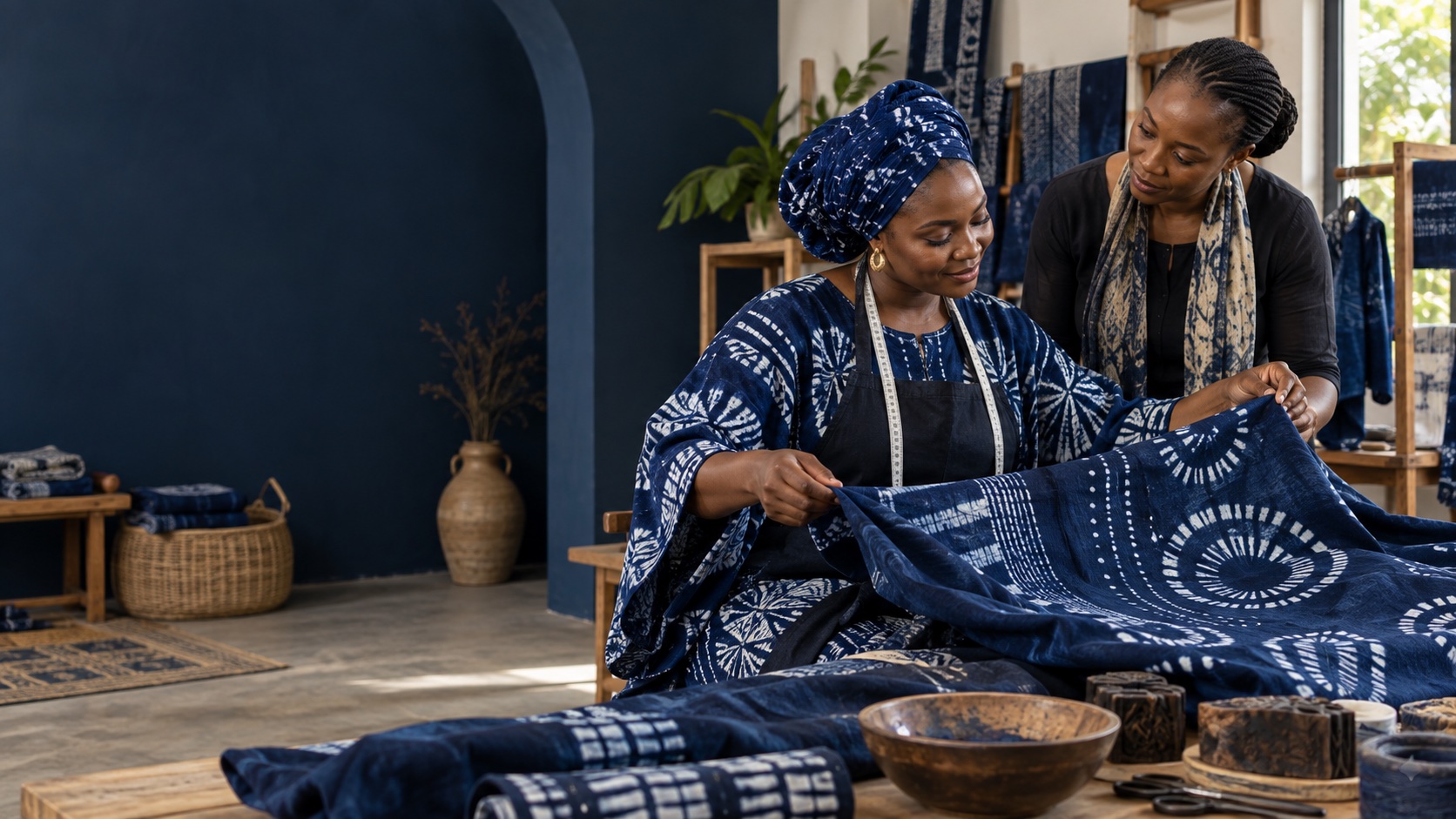
Adire is a centuries-old indigo-dyed textile tradition originating from the Yoruba people of Southwestern Nigeria. More than a fabric, it represents a living archive of cultural identity, storytelling and indigenous knowledge. Each motif is hand-crafted using resist-dye techniques passed down through generations, making Adire both an artistic expression and an economic livelihood for thousands of Nigerian women artisans and traders.
Yet this heritage is under growing threat. Local reports show a steady inflow of low-cost “adire-style” fabrics manufactured abroad and sold in Nigerian markets.
What’s Happening, Why It Matters. What’s Happening, Why It Matters.
What’s Happening,
Why It Matters.
The challenge of protecting Adire reflects a wider global dilemma facing traditional cultural expressions (TCEs). Across Nigeria, artisans and traders report lost sales, price undercutting and reputational dilution. The harm is both economic (lost income, shrinking artisan base) and cultural (erosion of control over forms, motifs and the meanings embedded in traditional designs). This mirrors what happens when TCEs are commodified overseas without consent or benefit-sharing for the source communities.
Protecting Adire therefore requires more than conventional intellectual property, which tends to recognise individual and time-bound rights. Instead, as an expression of traditional knowledge and collective creativity, it calls for frameworks that recognise communal and intergenerational ownership. The World Intellectual Property Organisation (WIPO) guidance highlights this mismatch and points toward sui generis systems and hybrid remedies as more effective pathways for safeguarding heritage like Adire.
Photo: "Tie and Dye to the rescue (Adire)" by Adeyinka Olaiya / CC BY-SA 4.0
https://commons.wikimedia.org/wiki/File:Tie_and_Dye_to_the_rescue_(Adire).jpg
CASE STUDIES IN PROTECTING INDIGENOUS CULTURAL ASSETSCASE STUDIES IN PROTECTING INDIGENOUS CULTURAL ASSETS
CASE STUDIES IN PROTECTING
INDIGENOUS CULTURAL ASSETS
https://www.un.org/sustainabledevelopment/blog/2016/05/ban-urges-un-system-to-bolster-support-for-indigenous-peoples/
Each year on 9 August, the United Nations marks the International Day of the World’s Indigenous Peoples, recognising the rights, contributions and distinct identities Indigenous Peoples worldwide. The day highlights their struggles for self-determination, cultural survival and equitable participation in global development.At the heart of these struggles is the protection of traditional knowledge (TK), traditional cultural expressions (TCEs) and genetic resources (GRs), all areas vulnerable to exploitation and misappropriation. From sacred designs and crafts to music, medicine and agricultural knowledge, Indigenous innovation is often commercialised without consent, benefit-sharing or recognition.The UN Declaration on the Rights of Indigenous Peoples (UNDRIP, 2007) affirms their right to maintain, control, protect and develop their cultural heritage and intellectual property. Each year on 9 August, the United Nations marks the International Day of the World’s Indigenous Peoples, recognising the rights, contributions and distinct identities Indigenous Peoples worldwide. The day highlights their struggles for self-determination, cultural survival and equitable participation in global development.At the heart of these struggles is the protection of traditional knowledge (TK), traditional cultural expressions (TCEs) and genetic resources (GRs), all areas vulnerable to exploitation and misappropriation. From sacred designs and crafts to music, medicine and agricultural knowledge, Indigenous innovation is often commercialised without consent, benefit-sharing or recognition.The UN Declaration on the Rights of Indigenous Peoples (UNDRIP, 2007) affirms their right to maintain, control, protect and develop their cultural heritage and intellectual property.
Each year on 9 August, the United Nations marks the International Day of the World’s Indigenous Peoples, recognising the rights, contributions and distinct identities Indigenous Peoples worldwide. The day highlights their struggles for self-determination, cultural survival and equitable participation in global development.
At the heart of these struggles is the protection of traditional knowledge (TK), traditional cultural expressions (TCEs) and genetic resources (GRs), all areas vulnerable to exploitation and misappropriation. From sacred designs and crafts to music, medicine and agricultural knowledge, Indigenous innovation is often commercialised without consent, benefit-sharing or recognition.
The UN Declaration on the Rights of Indigenous Peoples (UNDRIP, 2007) affirms their right to maintain, control, protect and develop their cultural heritage and intellectual property.
THE MĀORI AND THE TA MOKO, NEW ZEALAND THE MĀORI AND THE TA MOKO, NEW ZEALAND
THE MĀORI AND THE TA MOKO, NEW ZEALAND
Photo: Maori of New Zealand. owlcation photo.
https://tadexprof.com/british-colonisation-of-new-zealand/
The Māori people of New Zealand faced widespread commercial misuse of their traditional tattoo art, Ta Moko, by foreign designers and companies. In response, the New Zealand Intellectual Property Office introduced mechanisms to block offensive or culturally inappropriate trademark registrations. The Māori Advisory Committee was also established to ensure that trademarks or designs incorporating Māori culture are used respectfully and with permission.
Lesson for Nigeria: Establish a cultural advisory board under the Ministry of Trade or the Nigerian Copyright Commission to vet external applications involving Adire or other indigenous designs, ensuring local custodians have authority over their use.
NAVAJO NATION VS URBAN OUTFITTERS, UNITED STATES NAVAJO NATION VS URBAN OUTFITTERS, UNITED STATES
NAVAJO NATION VS URBAN OUTFITTERS,
UNITED STATES
Photo: The oldest, continuously operating trading post on the Navajo Nation by National Park Service Digital Image Archives, https://commons.wikimedia.org/wiki/File:Hubbell_Trading_Post_Birthplace_National_Historical_Site_HUTR3839.jpg
The Navajo Nation, one of the largest Native American tribes, sued fashion retailer Urban Outfitters for misusing the term “Navajo” on clothing and accessories. The tribe had registered “Navajo” as a trademark for textiles, clothing and jewellery. The case was settled in 2016 with an agreement that included collaboration between the Navajo Nation and Urban Outfitters.
Designs from Urban Outfitters' Navajo product line. Source/Urban Outfitters Designs from Urban Outfitters' Navajo product line. Source/Urban Outfitters Official Great Seal of the Navajo Nation by Navajoindianhttps://commons.wikimedia.org/wiki/File:Great_Seal_of_the_Navajo_Nation.png Official Great Seal of the Navajo Nation by Navajoindianhttps://commons.wikimedia.org/wiki/File:Great_Seal_of_the_Navajo_Nation.png
Designs from Urban Outfitters' Navajo product line. Source/Urban Outfitters
Official Great Seal of the Navajo
Nation by Navajoindian
https://commons.wikimedia.org/wiki/File:Great_Seal_of_the_Navajo_Nation.png
Lesson for Nigeria: Trademarks and collective marks can be powerful tools for Nigerian Adire cooperatives, enabling them to challenge misappropriation of their name or designs in global markets.
BANARASI SILK, INDIABANARASI SILK, INDIA
BANARASI SILK, INDIA
Photo: Weaving silk cloth by Esme Vos
https://commons.wikimedia.org/wiki/File:Weaving_silk_cloth.jpgr
India has successfully protected Banarasi Silk, a centuries-old weaving tradition, through a Geographical Indication (GI). The GI ensures that only silk produced in designated districts around Varanasi can be sold as “Banarasi.” This protects both producers and consumers from fakes while also preserving the craft.
Lesson for Nigeria: Nigeria could pursue a GI for Adire tied to regions such as Abeokuta and Osogbo, certifying origin and authenticity, while strengthening export potential.
ROOIBOS TEA, SOUTH AFRICAROOIBOS TEA, SOUTH AFRICA
ROOIBOS TEA, SOUTH AFRICA
Photo: Rooibos (Aspalathus linearis) by Winfried Bruenken (Amrum) https://commons.wikimedia.org/wiki/File:Rooibos_(Aspalathus_linearis).jpgPhoto: Rooibos (Aspalathus linearis) by Winfried Bruenken (Amrum) https://commons.wikimedia.org/wiki/File:Rooibos_(Aspalathus_linearis).jpg
Photo: Rooibos (Aspalathus linearis) by Winfried Bruenken (Amrum)
https://commons.wikimedia.org/wiki/File:Rooibos_(Aspalathus_linearis).jpg
South Africa secured a Geographical Indication (GI) for Rooibos Tea, ensuring the name can only be used for tea grown in specific regions of the Western Cape. This legal protection came after years of foreign companies exploiting the name without benefiting local farmers.
Photo: Keisarin Morsian on Nordqvist Oy:n valmistama tee by SprinkleSupreme, https://commons.wikimedia.org/wiki/File:Keisarin-morsian-rooibos-pussitee.jpgPhoto: Keisarin Morsian on Nordqvist Oy:n valmistama tee by SprinkleSupreme, https://commons.wikimedia.org/wiki/File:Keisarin-morsian-rooibos-pussitee.jpg
Photo: Keisarin Morsian on Nordqvist Oy:n valmistama tee
by SprinkleSupreme,
https://commons.wikimedia.org/wiki/File:Keisarin-morsian-rooibos-pussitee.jpg
Lesson for Nigeria: Beyond textiles, Nigeria can extend GI protection to other cultural and agricultural products, positioning them as globally competitive while safeguarding indigenous ownership.
WORLD INTERNATIONAL PROPERTY DAY APRIL 26WORLD INTERNATIONAL PROPERTY DAY APRIL 26
WORLD INTERNATIONAL PROPERTY DAY APRIL 26
IP & SMEs: Taking your ideas to market, World Intellectual Property Day – April 26, 2021
https://www.wipo.int/en/web/ipday/2021/index
World Intellectual Property Day on April 26 highlights the rights of Indigenous Peoples and youth to protect, control and benefit from their knowledge, cultural expressions and innovations. Safeguarding these assets affirms self-determination, while the active participation of Indigenous youth remains crucial in shaping IP decisions that affect their future.
IMPLICATIONS FOR NIGERIA’S ADIRE
These cases show that indigenous communities can successfully use intellectual property systems to protect cultural assets. Whether through trademarks, collective marks or geographical indications, protection provides four major benefits:
Economic Empowerment: Local producers and traders gain exclusive rights, improving income, market power and long-term livelihoods.
Industry Development: Protection fosters a structured Adire value chain, supporting artisan clusters, SMEs and larger enterprises in scaling production while maintaining authenticity.
Cultural Preservation: Traditions, motifs and meanings are safeguarded against distortion and misappropriation.
Global Competitiveness: Legal protection strengthens Nigeria’s creative economy by enabling premium branding opportunities in regional and international markets.
PROTECTING ADIRE: PROPOSED ROADMAP PROTECTING ADIRE: PROPOSED ROADMAP
PROTECTING ADIRE: PROPOSED ROADMAP
INTELLECTUAL PROPERTY: A CASE FOR ADIREINTELLECTUAL PROPERTY: A CASE FOR ADIRE
INTELLECTUAL PROPERTY:
A CASE FOR ADIRE
still-life-intellectual-property-day.jgp, www.freepik.com
Drawing from international best practices and the urgent need to safeguard Nigeria’s indigenous textile heritage, Concinnity proposes the following roadmap for protecting Adire and strengthening the broader creative economy:
1. LEGAL PROTECTION THROUGH IP AND GI INSTRUMENTS
Collective Trademark Registration: Register “Adire” as a collective mark with the Nigerian Trademarks Registry to ensure that only authorised producers and cooperatives can market authentic Adire.
Geographical Indication (GI): Pursue GI registration for Adire tied to cultural centres such as Abeokuta and Osogbo, guaranteeing authenticity linked to origin.
2. INSTITUTIONAL AND POLICY ADVOCACY
Cultural Advisory Committee: Establish a national advisory body comprising Adire guilds, textile experts, and cultural custodians to oversee IP applications and safeguard traditional designs.
Policy Alignment: Work with the Federal Ministry of Industry, Trade and Investment, NBTE, and the Nigerian Copyright Commission to integrate Adire into Nigeria’s IP and creative industry policies.
Photo: Statue representing the process of ADIRE in Itoku market, Abeokuta, Ogun state, Nigeria, by Solanke Lukman Oluwaseun, https://commons.wikimedia.org/wiki/File:Adire_Mall,_Itoku_Abeokuta_(3).jpg
3. PRODUCER EMPOWERMENT AND CAPACITY BUILDING
Training on IP Rights: Educate Adire producers and SMEs on the use of trademarks, GIs, and copyright as tools to protect their designs.
Cooperative Strengthening: Encourage traders and producers to form stronger associations or cooperatives, enabling them to act collectively in enforcing rights and pursuing export opportunities.
4. MARKET DEVELOPMENT AND GLOBAL POSITIONING
Authenticity Labelling: Introduce certification tags or holograms for authentic Adire, similar to “Made in Italy” or “Handwoven in Varanasi.”
Export Strategy: Position Adire as a premium cultural product in international creative and fashion markets, targeting diaspora communities, ethical fashion brands, and cultural tourism sectors.
5. KNOWLEDGE SHARING AND COLLABORATION
Global Exchange: Facilitate learning from case studies like India’s Banarasi silk and South Africa’s Rooibos Tea by building partnerships with global IP bodies such as WIPO.
Research and Documentation: Support documentation of Adire techniques, stories, and motifs to strengthen claims of authenticity and cultural ownership.
Intellectual Property: Catalyst for Nigeria’s Creative EconomyIntellectual Property: Catalyst for Nigeria’s Creative Economy
Intellectual Property:
Catalyst for Nigeria’s Creative Economy
World Ip Day Celebration at the WIPO Nigeria Office
https://www.wipo.int/en/web/office-nigeria/w/news/2025/world-ip-day-celebration-nigeria-office
CONCLUSION
The WIPO Nigeria Office marked World IP Day 2025 by highlighting IP’s role in fostering creativity, innovation and economic growth, with Nigeria’s music sector as a case study. The protection of Adire illustrates the broader need to safeguard traditional cultural expressions as economic, cultural and identity assets.
Embedding IP into Nigeria’s creative economy strategy can secure fair benefits for communities, preserve authenticity and boost global competitiveness. More broadly, a coherent IP framework is essential to bridge traditional knowledge and modern markets, enabling Nigeria’s creative legacies to drive prosperity, resilience and international recognition.
Prepared by
The Concinnity Solutions Watch Team
info@concinnityng.com